5 Mark Mark #177
Darlehnskassenschein Series
(1914–1922)
· issued 1917
· P-56b
· common
Type details
| Country | Germany |
| Currency | Mark |
| Denomination | 5 Mark |
| Series | Darlehnskassenschein Series |
| Series year | 1917 |
| Series range | 1914–1922 |
| Issue year | 1917 |
| Issuer | Reichsschuldenverwaltung |
| Issuer (native) | Reichsschuldenverwaltung |
| Printer | Reichsdruckerei |
| Front portrait | Germania |
| Reverse subject | German Imperial Eagle |
| Themes | mythology,statesman |
| Security features | intaglio,microprint |
| Colour palette | #4a6b4a,#d4c5a0,#2c2c2c |
| Material | paper |
| Dimensions (mm) | 145x95 |
| Language / script | Fraktur |
| Languages | de |
| Pick # | P-56b |
| Rarity | common |
| Legal status | demonetized |
| Legal status date | 1922 |
| Successor currency | Rentenmark |
| Era | 1900_1945 |
| Default value (low) | 5.0 |
| Default value (high) | 15.0 |
| Value currency | USD |
Front
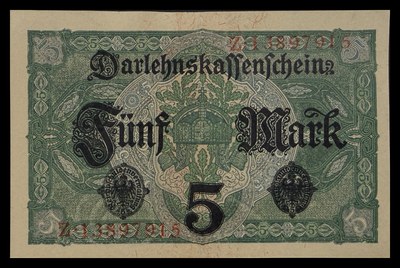
Ornate decorative design with Gothic text 'Darlehnskassenschein' (Loan Bank Certificate) and 'Fünf Mark' (Five Mark). The Darlehnskassenscheine were emergency paper money issued by the German Empire during World War I to finance the war effort, authorized by the Reichsschuldenverwaltung (Imperial Debt Administration). These notes circulated alongside Reichsbanknoten and were backed by war loans rather than gold reserves.
Back
Germania, the national personification of Germany, depicted as a young woman wearing a laurel wreath and flowers in her hair. The German Imperial Eagle (Reichsadler) appears at upper left. Text reads 'Fünf Mark' and 'Berlin, den 1. August 1917' with 'Reichsschuldenverwaltung' below. Germania was a common allegorical figure on German currency representing the nation's strength and unity during the imperial period.
History
The Darlehnskassenscheine (Loan Bank Certificates) were emergency currency issued by the German Empire during World War I from 1914 to 1922. The 5 Mark note dated August 1, 1917 was part of the wartime financing mechanism, backed by war bonds rather than gold reserves. These notes were issued by the Reichsschuldenverwaltung (Imperial Debt Administration) and printed by the Reichsdruckerei in Berlin. They circulated until the hyperinflation crisis led to their replacement by the Rentenmark in 1923-1924. The Pick-56b variant features specific signature combinations and serial number styles that distinguish it from earlier and later printings.
Linked specimens (1)
Merge into another type
Repoints every linked specimen above to the chosen target type, fills any target nulls from this type, then deletes this type. This cannot be undone.