Type details
| Country | Germany |
| Currency | Rentenmark |
| Denomination | 1 |
| Series | Rentenmark series |
| Series year | 1937 |
| Series range | 1923–1948 |
| Issue year | 1937 |
| Issuer | Deutsche Rentenbank |
| Issuer (native) | Deutsche Rentenbank |
| Reverse subject | Wheat sheaf |
| Themes | agriculture,industry |
| Watermark | Circular watermark with '1 Rentenmark' visible at right |
| Security features | watermark,microprint,intaglio |
| Colour palette | #8b7355,#d4c5a9,#1a1a1a |
| Material | paper |
| Dimensions (mm) | 105x60 |
| Language / script | Latin |
| Languages | de |
| Pick # | P-173b |
| Rarity | common |
| Legal status | demonetized |
| Legal status date | 1948 |
| Predecessor currency | Papiermark |
| Successor currency | Deutsche Mark |
| Era | 1900_1945 |
| Default value (low) | 3.0 |
| Default value (high) | 8.0 |
| Value currency | USD |
Front
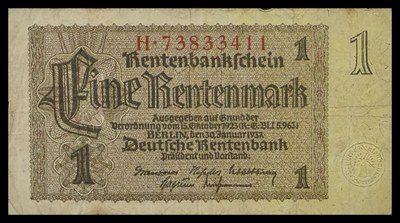
German Rentenmark issued by the Deutsche Rentenbank in Berlin, dated 30 January 1937. The Rentenmark was introduced in November 1923 as an emergency currency to stabilize Germany's economy during the hyperinflation crisis of the Weimar Republic. Although officially replaced by the Reichsmark in 1924, Rentenmark notes continued to be issued and circulated alongside Reichsmarks until 1948. The note reads 'Ausgegeben auf Grund der Verordnung vom 15. Oktober 1923' (Issued on the basis of the ordinance of 15 October 1923), referencing the original decree that established this currency. The denomination '1 Fünf Rentenmark' appears in ornate Gothic script.
Back
Wheat sheaf bound with rope at center left, symbolizing agricultural production and the land-backed security of the Rentenmark. The currency was initially backed by mortgages on German agricultural and industrial assets (hence 'Renten' meaning rents or yields). The denomination '1 Rentenmark' and 'Eine Rentenmark' appears in decorative medallions. The reverse includes the warning text about counterfeiting penalties running vertically along the left edge.
History
Rentenmark series, 1923–1948. The Rentenmark was introduced on 15 October 1923 at the height of Weimar hyperinflation, when the Papiermark had become virtually worthless. Backed by mortgages on German land and industry rather than gold, it successfully stabilized the economy by limiting issuance. The exchange rate was set at 1 Rentenmark = 1 trillion (10¹²) Papiermarks. Although the Reichsmark officially replaced it in 1924, the Rentenbank continued issuing notes with dates extending to 1937, and they remained legal tender until the 1948 currency reform. This 1937-dated issue represents one of the later printings. The series is notable for being one of the most successful emergency currencies in history, effectively ending hyperinflation within weeks of introduction.
Linked specimens (1)
Merge into another type
Repoints every linked specimen above to the chosen target type, fills any target nulls from this type, then deletes this type. This cannot be undone.