50000000 Mark #181
Third Inflation Issue
(1923–1924)
· issued 1923
· 109d
· common
Type details
| Country | Germany |
| Currency | Mark |
| Denomination | 50000000 |
| Series | Third Inflation Issue |
| Series year | 1923 |
| Series range | 1923–1924 |
| Issue year | 1923 |
| Issuer | Reichsbankdirektorium |
| Issuer (native) | Reichsbankdirektorium |
| Signatures | Reichsbankdirektorium officials |
| Printer | Reichsdruckerei |
| Reverse subject | Plain reverse with serial number |
| Themes | commemorative |
| Watermark | No watermark |
| Security features | microprint,intaglio |
| Colour palette | #d4a574,#8b4513,#2f2f2f |
| Material | paper |
| Dimensions (mm) | 192x100 |
| Language / script | Latin |
| Languages | de |
| Pick # | 109d |
| Rarity | common |
| Legal status | demonetized |
| Legal status date | 1924 |
| Predecessor currency | Papiermark |
| Successor currency | Rentenmark |
| Era | 1900_1945 |
| Default value (low) | 2.0 |
| Default value (high) | 8.0 |
| Value currency | USD |
Front
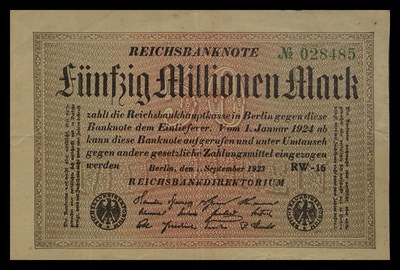
German hyperinflation note of 50 million Mark issued during the catastrophic inflation of 1923. The text states this Reichsbanknote is redeemable by the Reichsbank at its counters from 1 January 1924, and can be exchanged freely against other legal tender payment methods. The note bears the Weimar Republic eagle emblem on both lower corners and was issued by the Reichsbankdirektorium in Berlin on 1 September 1923, marked with reference RW-16. This denomination reflects the exponential currency devaluation of the Weimar Republic, when a loaf of bread cost billions of marks.
Back
Plain reverse with only serial number visible in upper left corner. The minimalist back design was typical of emergency hyperinflation notes issued during this period, as resources were devoted to rapidly printing currency to meet demand rather than elaborate security features or designs.
History
This note belongs to the Third Inflation Issue of 1923, part of Germany's hyperinflation period during the Weimar Republic. By September 1923, the German mark had lost virtually all value due to the government's policy of printing money to pay war reparations and cover budget deficits. The inflation peaked in November 1923, when the exchange rate reached 4.2 trillion marks to one US dollar. The crisis ended with the introduction of the Rentenmark in November 1923 and the Reichsmark in 1924, which replaced the old mark at a rate of 1 trillion to 1. This 50-million-mark note, though enormous in face value, had minimal purchasing power when issued.
Linked specimens (1)
Merge into another type
Repoints every linked specimen above to the chosen target type, fills any target nulls from this type, then deletes this type. This cannot be undone.