10 Reichsmark #182
Weimar Republic series
(1929–1945)
· issued 1929
· 180a
· common
Type details
| Country | Germany |
| Currency | Reichsmark |
| Denomination | 10 |
| Series | Weimar Republic series |
| Series year | 1929 |
| Series range | 1929–1945 |
| Issue year | 1929 |
| Issuer | Reichsbank |
| Issuer (native) | Reichsbank |
| Printer | Reichsdruckerei |
| Front portrait | Albrecht Dürer |
| Reverse subject | Allegorical figures representing art and science |
| Themes | artist,architecture |
| Security features | microprint,intaglio |
| Colour palette | #5a6b4d,#d4c9a8,#3a4530 |
| Material | paper |
| Dimensions (mm) | 105x63 |
| Language / script | Latin,Fraktur |
| Languages | de |
| Pick # | 180a |
| Rarity | common |
| Legal status | demonetized |
| Legal status date | 1948 |
| Predecessor currency | Rentenmark |
| Successor currency | Deutsche Mark |
| Era | 1900_1945 |
| Default value (low) | 5.0 |
| Default value (high) | 15.0 |
| Value currency | USD |
Front
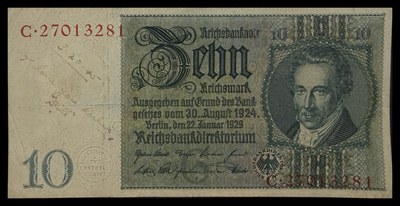
Albrecht Dürer (1471–1528), German Renaissance painter, printmaker, and theorist, widely regarded as the greatest artist of the Northern Renaissance. His portrait appears at right, based on his famous self-portrait. Dürer revolutionized printmaking and was one of the first European artists to gain international fame during his lifetime. The note includes Gothic script text indicating it was issued on the basis of the Bank Act of 30 August 1924, later amended 22 January 1929, making it redeemable at the Reichsbank.
Back
Allegorical figures representing the arts and sciences appear in ornamental panels on either side of a central medallion. The left panel depicts a figure holding artistic implements, while the right panel shows a figure with attributes of learning or wisdom. These neoclassical allegorical representations emphasize Germany's cultural and intellectual heritage during the Weimar Republic period.
History
This note belongs to the Reichsmark series issued by the Reichsbank during the Weimar Republic, following the stabilization of German currency after the hyperinflation crisis of 1923. The Reichsmark was introduced in 1924 to replace the Rentenmark and remained Germany's official currency until 1948, when it was replaced by the Deutsche Mark in West Germany and the East German mark in East Germany. The 1929 series notes featured prominent German cultural figures, with Dürer chosen for the 10 Reichsmark denomination to celebrate Germany's artistic heritage. These notes were printed by the Reichsdruckerei (Reich Printing Works) in Berlin and remained in circulation throughout the Nazi period and World War II.
Linked specimens (1)
Merge into another type
Repoints every linked specimen above to the chosen target type, fills any target nulls from this type, then deletes this type. This cannot be undone.