Type details
| Country | Germany |
| Currency | Mark |
| Denomination | 500 |
| Series | Third Reich Issue |
| Series year | 1922 |
| Series range | 1922–1923 |
| Issue year | 1922 |
| Issuer | Reichsbank |
| Issuer (native) | Reichsbank |
| Signatures | Reichsbankdirektorium: Havenstein, Bauernfeind, Schmidt Wächter, Günther Knäfel Carl Friedmann, Schacht |
| Printer | Reichsdruckerei |
| Themes | statesman |
| Security features | microprint |
| Colour palette | #c4b5a0,#000000,#8b7355 |
| Material | paper |
| Dimensions (mm) | 210x115 |
| Language / script | Fraktur (blackletter) |
| Languages | de |
| Pick # | P-74b |
| Rarity | common |
| Legal status | demonetized |
| Legal status date | 1923 |
| Successor currency | Rentenmark |
| Era | 1900_1945 |
| Default value (low) | 5.0 |
| Default value (high) | 15.0 |
| Value currency | USD |
Front
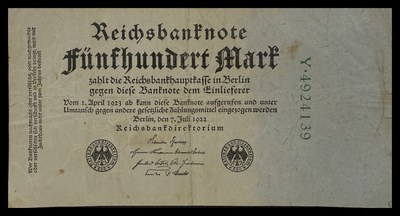
German Reichsbanknote of 500 Mark issued during the Weimar Republic hyperinflation period. The note bears the date 7 July 1922 (Berlin, den 7. Juli 1922) and features two circular seals of the Reichsbank with the imperial eagle (Reichsadler) at left and right. Multiple signatures of the Reichsbankdirektorium (Reich Bank Directorate) appear in the center. The text states that the Reichsbank main office in Berlin pays 500 Mark to the bearer, and that from 1 April 1923 onwards this note can be recalled and exchanged for other legal tender. This note represents the early phase of the catastrophic German hyperinflation that would peak in 1923.
Back
Plain reverse with no printing, showing only the paper substrate with some age discoloration and staining. The blank reverse was typical of many German emergency and inflation-era notes of this period, printed hastily to meet massive demand for currency during the hyperinflation crisis.
History
Part of the Reichsbanknote series issued 1922–1923 during the Weimar Republic's catastrophic hyperinflation. The 500 Mark denomination was issued on 7 July 1922, when inflation was already severe but would accelerate dramatically through 1923. The note includes a clause stating it could be recalled from 1 April 1923 for exchange—reflecting authorities' attempts to manage the currency crisis. By late 1923, the Mark had become virtually worthless, with notes in the trillions being issued before the Rentenmark stabilized the currency in November 1923. These notes were printed by the Reichsdruckerei (Reich Printing Office) in vast quantities, often with minimal security features due to the urgent need for currency. The serial number format with prefix 'V' and alphanumeric sequence was typical of this series.
Linked specimens (1)
Merge into another type
Repoints every linked specimen above to the chosen target type, fills any target nulls from this type, then deletes this type. This cannot be undone.