Type details
| Country | Germany |
| Currency | Reichsmark |
| Denomination | 10 |
| Series | Reichsbanknote Series 1929 |
| Series year | 1929 |
| Series range | 1929–1945 |
| Issuer | Reichsbank |
| Issuer (native) | Reichsbank |
| Signatures | Reichsbankdirektorium signature visible |
| Printer | Reichsdruckerei |
| Themes | statesman |
| Watermark | Geometric pattern with denomination numeral |
| Security features | intaglio,microprint |
| Colour palette | #8b7355,#2f4f2f,#d4a574 |
| Material | paper |
| Dimensions (mm) | 148x82 |
| Language / script | Latin (Fraktur) |
| Languages | de |
| Pick # | P-180a |
| Rarity | common |
| Legal status | demonetized |
| Legal status date | 1948-06-20 |
| Predecessor currency | Rentenmark |
| Successor currency | Deutsche Mark |
| Era | 1900_1945 |
| Default value (low) | 5.0 |
| Default value (high) | 20.0 |
| Value currency | USD |
Front
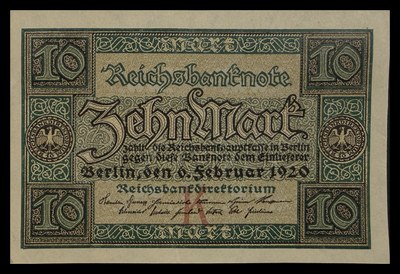
This 10 Reichsmark note displays the Weimar Republic eagle emblem in circular seals at left and right. The text 'Reichsbanknote Zehn Mark' appears in Gothic blackletter (Fraktur) script with ornate decorative borders. The inscription reads 'Nach dem Reichsbankgesetz vom 30. August 1924 für die Reichsbankkasse strafbar' (After the Reichsbank law of 30 August 1924, counterfeiters will be punished). This series was introduced during the Weimar Republic following the stabilization of German currency after the hyperinflation crisis of 1923.
Back
Elaborate geometric and arabesque pattern with denomination numeral '10' at center. The design features intricate scrollwork borders with repeated text warning against counterfeiting: 'Wer Banknoten nachmacht oder verfälscht oder nachgemachte oder verfälschte sich verschafft und in Verkehr bringt wird mit Zuchthaus nicht unter zwei Jahren bestraft' (Whoever counterfeits or falsifies banknotes or procures and circulates counterfeited or falsified notes will be punished with imprisonment of no less than two years). The decorative style reflects the transition from Imperial to Weimar design aesthetics.
History
The Reichsmark was introduced in 1924 to replace the Rentenmark and stabilize German currency after the catastrophic hyperinflation of 1923. The 1929 series, printed by the Reichsdruckerei (Reich Printing Works), continued to circulate through the Nazi period and World War II until currency reform in 1948 when it was replaced by the Deutsche Mark in West Germany and the East German Mark in the Soviet zone. This 10 Reichsmark denomination was a common mid-value note used for everyday transactions throughout the Weimar and Nazi eras.
Linked specimens (1)
Merge into another type
Repoints every linked specimen above to the chosen target type, fills any target nulls from this type, then deletes this type. This cannot be undone.