1000 Reichsmark #199
Reichsbanknote Series 1910
(1910–1914)
· issued 1910
· P-44
· common
Type details
| Country | Germany |
| Currency | Reichsmark |
| Denomination | 1000 |
| Series | Reichsbanknote Series 1910 |
| Series year | 1910 |
| Series range | 1910–1914 |
| Issue year | 1910 |
| Issuer | Reichsbank |
| Issuer (native) | Reichsbank |
| Printer | Reichsdruckerei |
| Reverse subject | Imperial Coat of Arms of Germany |
| Themes | statesman,monarchy |
| Security features | intaglio,microprint |
| Colour palette | #8b7d6b,#d4a574,#c85a54 |
| Material | paper |
| Dimensions (mm) | 210x125 |
| Language / script | Latin (Fraktur) |
| Languages | de |
| Pick # | P-44 |
| Rarity | common |
| Legal status | demonetized |
| Legal status date | 1924 |
| Predecessor currency | German Papiermark |
| Successor currency | Rentenmark |
| Era | 1900_1945 |
| Default value (low) | 15.0 |
| Default value (high) | 40.0 |
| Value currency | USD |
Front
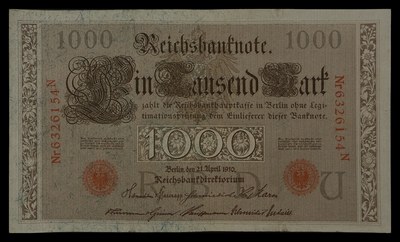
German Empire 1000 Mark Reichsbanknote issued 21 April 1910. The text 'Ein Tausend Mark' (One Thousand Marks) appears in ornate Gothic lettering with the payment clause stating the note is payable at the Reichshauptbankasse in Berlin without legitimation check to the bearer. The date 'Berlin den 21 April 1910' is clearly printed along with 'Reichsbankdirektorium' and signatures of bank officials. This design represents the Imperial German monetary system before World War I.
Back
Imperial Coat of Arms of Germany (Reichswappen) supported by two allegorical female figures representing German states or virtues. The double-headed eagle bears the Prussian shield at center, surrounded by elaborate heraldic ornamentation typical of the German Empire period (1871–1918). The design symbolizes the unity and power of the German Reich under the Hohenzollern dynasty.
History
This note belongs to the Reichsbanknote series issued by the German Empire's Reichsbank beginning in 1906 and continuing through 1914. The 1910 issue predates World War I and represents the stable monetary system of Imperial Germany. These notes were eventually superseded during the hyperinflation of the Weimar Republic (1919–1923) and formally replaced by the Rentenmark in 1923 and then the Reichsmark in 1924. The ornate design reflects the artistic style and imperial symbolism of the Wilhelmine era.
Linked specimens (1)
Merge into another type
Repoints every linked specimen above to the chosen target type, fills any target nulls from this type, then deletes this type. This cannot be undone.