20 Reichsmark #206
Reichsbanknote Series 1929
(1929–1945)
· issued 1929
· R-181a
· common
Type details
| Country | Germany |
| Currency | Reichsmark |
| Denomination | 20 |
| Series | Reichsbanknote Series 1929 |
| Series year | 1929 |
| Series range | 1929–1945 |
| Issue year | 1929 |
| Issuer | Reichsbank |
| Issuer (native) | Reichsbank |
| Printer | Reichsdruckerei |
| Reverse subject | Ornamental design with allegorical figures and flora |
| Themes | agriculture,industry |
| Watermark | Large denomination numeral 20 in central oval field |
| Security features | microprint,intaglio |
| Colour palette | #8b7355,#5a4a3a,#d4c4a8 |
| Material | paper |
| Dimensions (mm) | 148x105 |
| Language / script | Latin (Fraktur) |
| Languages | de |
| Pick # | R-181a |
| Rarity | common |
| Legal status | demonetized |
| Legal status date | 1948 |
| Predecessor currency | Rentenmark |
| Successor currency | Deutsche Mark |
| Era | 1900_1945 |
| Default value (low) | 8.0 |
| Default value (high) | 15.0 |
| Value currency | USD |
Front
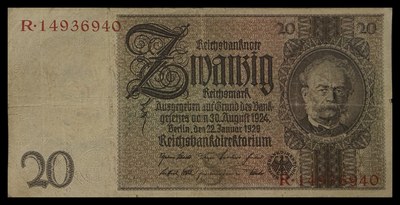
20 Reichsmark banknote issued under the Weimar Republic. The front bears elaborate Gothic text reading 'Zwanzig Reichsmark' with legal text referencing the banking law of 30 August 1924 and the penal law of 2 January 1929. The design features ornate guilloche patterns typical of Reichsbank notes of this period, with denomination numerals in the corners. These notes were issued during the stabilization period following the hyperinflation crisis of 1923, when the Reichsmark replaced the Rentenmark at par.
Back
Ornamental reverse design featuring allegorical figures representing German labor and agriculture. On the left, a male figure with tools symbolizes industry; on the right, a female figure with agricultural produce represents farming. The central oval watermark area is surrounded by intricate guilloche work and floral motifs, reflecting the nationalist artistic style of the Weimar period. The denomination '20' appears in all four corners.
History
This note belongs to the Reichsbanknote series introduced in 1924 following Germany's devastating hyperinflation. The Reichsmark was established at a rate of 1 Reichsmark = 1 trillion Papiermark. The 1929 series continued through the Weimar Republic, the Third Reich period, and remained in circulation until currency reform in 1948 when it was replaced by the Deutsche Mark in West Germany and the Mark der DDR in East Germany. The 'R' prefix on the serial number indicates this is a replacement note, used to substitute notes destroyed during production.
Linked specimens (1)
Merge into another type
Repoints every linked specimen above to the chosen target type, fills any target nulls from this type, then deletes this type. This cannot be undone.