Type details
| Country | Greece |
| Currency | GRD |
| Denomination | 1000 |
| Series | 1987 Series |
| Series year | 1987 |
| Series range | 1987-2001 |
| Issue year | 1987 |
| Issuer | Bank of Greece |
| Issuer (native) | ΤΡΑΠΕΖΑ ΤΗΣ ΕΛΛΑΔΟΣ |
| Signatures | Governor: Dimitrios Chalikias; Cashier: Alexandros Lazarides |
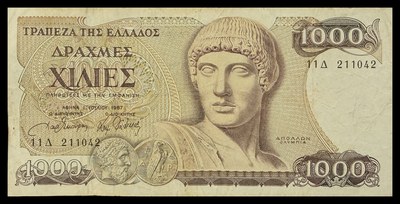
| Front portrait | Apollo of the Belvedere |
| Reverse subject | Ancient Olympia archaeological site |
| Themes | mythology,architecture,sport |
| Watermark | Portrait of Apollo of the Belvedere |
| Security features | thread,intaglio,watermark |
| Colour palette | #d4c5a0,#8b7355,#a0865c |
| Material | paper |
| Dimensions (mm) | 163x81 |
| Language / script | Greek |
| Languages | el |
| Pick # | P-202a |
| Rarity | common |
| Legal status | demonetized |
| Legal status date | 2002-02-28 |
| Successor currency | Euro |
| Era | 1946_1989 |
| Default value (low) | 3.0 |
| Default value (high) | 8.0 |
| Value currency | USD |
Front
Apollo of the Belvedere, a Roman marble copy (c. 120–140 AD) of a lost Greek bronze original by Leochares (c. 330 BC), depicting the Greek god Apollo. The sculpture is one of the most celebrated works of classical antiquity and has been housed in the Vatican Museums since the Renaissance. Apollo, god of light, music, poetry, prophecy and the arts, was central to Greek religion and culture; his image on this banknote symbolizes Greece's classical heritage and cultural identity.
Back
The archaeological site of Ancient Olympia in the Peloponnese, birthplace of the Olympic Games beginning in 776 BC. The ruins shown include Doric columns from the Temple of Zeus and surrounding structures of the sanctuary. A discus thrower (discobolus) appears at left, referencing the athletic competitions held at Olympia every four years in honour of Zeus. The site remains one of Greece's most significant archaeological treasures and a symbol of the Olympic spirit.
History
This note belongs to the 1987 series of Greek drachma banknotes issued by the Bank of Greece (Τράπεζα της Ελλάδος) and remained in circulation until Greece adopted the euro on 1 January 2002. The 1000 drachma denomination was one of the higher-value notes in daily use during the late 20th century. The design reflects Greece's emphasis on its classical heritage, featuring motifs from ancient Greek art and archaeology. The note was printed on security paper with intaglio engraving and incorporated a watermark of Apollo's profile. It was demonetized on 28 February 2002 following the euro transition.
Linked specimens (1)
Merge into another type
Repoints every linked specimen above to the chosen target type, fills any target nulls from this type, then deletes this type. This cannot be undone.