Type details
| Country | Guatemala |
| Currency | GTQ |
| Denomination | 0.50 |
| Series | Quetzal series |
| Series range | 1983–present |
| Issue year | 1988 |
| Issuer | Banco de Guatemala |
| Signatures | Presidente: [illegible]; Gerente: [illegible] |
| Printer | De La Rue |
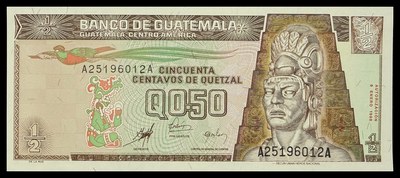
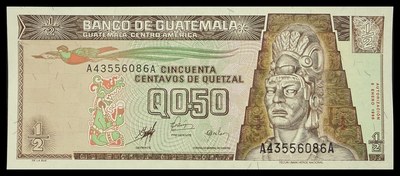
| Front portrait | Tecún Umán |
| Reverse subject | Temple I at Tikal |
| Themes | indigenous_culture,military,architecture,mythology |
| Watermark | Tecún Umán portrait in clear field at right |
| Security features | thread,microprint,intaglio |
| Colour palette | #8b7355,#9acd32,#d2b48c |
| Material | paper |
| Dimensions (mm) | 156x67 |
| Language / script | Latin |
| Languages | es |
| Pick # | 65 |
| Rarity | common |
| Legal status | in_circulation |
| Legal status date | 1998 |
| Era | 1990_present |
| Default value (low) | 1.0 |
| Default value (high) | 3.0 |
| Value currency | USD |
Front
Tecún Umán (died 1524), the last ruler and military leader of the K'iche' Maya who led resistance against Spanish conquistador Pedro de Alvarado. He is Guatemala's national hero, honoured for his defence of indigenous territory during the Spanish conquest. The note features a Maya stone stela depicting Tecún Umán in ceremonial regalia with elaborate headdress, alongside Maya glyphs and the quetzal bird motif—Guatemala's national symbol from which the currency takes its name.
Back
Temple I (Temple of the Great Jaguar) at Tikal, the ancient Maya city in the Petén Basin of northern Guatemala. Built circa 732 CE as the funerary temple for Jasaw Chan K'awiil I, this 47-metre pyramid is one of the most iconic structures of Classic Maya civilization and a UNESCO World Heritage Site. The temple is shown with surrounding jungle vegetation and additional Maya hieroglyphic decoration.
History
This ½ Quetzal note (50 centavos de Quetzal) belongs to the modern Quetzal series issued by the Banco de Guatemala beginning in 1983, when Guatemala adopted decimal subdivision for its currency. The design celebrates indigenous Maya heritage, featuring the legendary warrior Tecún Umán and the archaeological splendour of Tikal. The Quetzal replaced the Peso in 1925 and remains Guatemala's currency. These fractional denomination notes serve everyday commerce and are printed by De La Rue with security features standard for the series.