Type details
| Country | Guernsey |
| Currency | GBP |
| Denomination | 1 Pound |
| Series | Series C |
| Series range | 1980–1991 |
| Issuer | States of Guernsey |
| Signatures | States Treasurer: D. M. Clark |
| Printer | Bradbury Wilkinson & Co. |
| Reverse subject | Daniel de Lisle Brock |
| Themes | statesman,architecture |
| Watermark | Guernsey coat of arms |
| Security features | watermark,thread,intaglio,microprint |
| Colour palette | #a8d5a8,#6b8e6b,#e8d7a0 |
| Material | paper |
| Dimensions (mm) | 151x80 |
| Language / script | Latin |
| Languages | en |
| Pick # | P-48 |
| Rarity | common |
| Legal status | withdrawn |
| Legal status date | 1991 |
| Era | 1946_1989 |
| Default value (low) | 8.0 |
| Default value (high) | 25.0 |
| Value currency | GBP |
Front
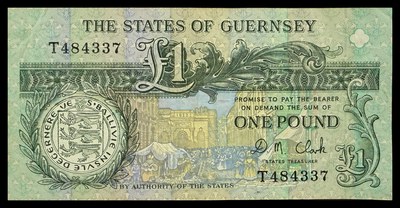
The Royal Court building in St. Peter Port with the year 1822 inscribed, showing a market scene with merchants and townsfolk in period dress. The Royal Court serves as Guernsey's court of justice and parliament building, constructed on its current site in 1799–1822. The Guernsey coat of arms with three lions passant guardant appears on the left, reflecting the island's historical connection to the Duchy of Normandy and the English Crown.
Back
Daniel de Lisle Brock (1762–1842), Bailiff of Guernsey from 1821 to 1842, depicted alongside the Royal Court building in St. Peter Port as it appeared in 1840. Brock was a prominent jurist and administrator during a critical period of Guernsey's constitutional development. The building shown is the Royal Court, the seat of judicial and legislative authority in the Bailiwick.
History
This note belongs to Series C of States of Guernsey banknotes, issued from 1980 to 1991. The series featured Guernsey's constitutional history and key figures in the island's governance. Series C was replaced by Series D notes beginning in 1991. The States of Guernsey has issued its own sterling currency since 1827 under the authority granted by the British Crown, with Guernsey pounds circulating alongside Bank of England notes at par. Daniel de Lisle Brock was honoured on this denomination for his long service as Bailiff during the early 19th century. The notes were printed by Bradbury Wilkinson & Co., a British security printer known for Commonwealth and Crown Dependency banknotes.