Type details
| Country | India |
| Currency | INR |
| Denomination | 1 Rupee |
| Series | Government of India Issue |
| Series range | 1985-1994 |
| Issuer | Government of India |
| Issuer (native) | भारत सरकार |
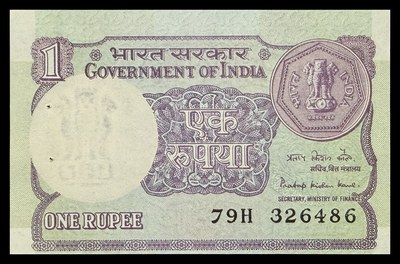
| Signatures | Secretary, Ministry of Finance: Pratap Kishan Kaul |
| Printer | Government of India Security Press |
| Reverse subject | Oil rig platform |
| Themes | industry |
| Watermark | Ashoka Pillar emblem in clear field at left |
| Security features | watermark,intaglio,microprint |
| Colour palette | #c8d5b9,#b39bc8,#f5e6d3 |
| Material | paper |
| Dimensions (mm) | 117x63 |
| Language / script | Devanagari,Latin |
| Languages | hi,en |
| Pick # | 78Aa |
| Rarity | common |
| Legal status | demonetized |
| Legal status date | 1994 |
| Era | 1990_present |
| Default value (low) | 2.0 |
| Default value (high) | 5.0 |
| Value currency | USD |
Front
The Ashoka Pillar capital, featuring four Asiatic lions standing back to back, India's national emblem adopted from the Lion Capital of Ashoka at Sarnath (circa 250 BCE). The emblem symbolizes power, courage, and confidence; the lions rest on an abacus decorated with a chakra (wheel) flanked by animals. The note displays the denomination 'Ek Rupaya' (One Rupee) in Hindi Devanagari script prominently at center, with 'Government of India' in both English and Hindi. This design represents the small-denomination government-issued currency notes, distinct from Reserve Bank of India notes.
Back
An offshore oil drilling platform representing India's petroleum industry and energy sector development. The oil rig symbolizes India's efforts toward self-sufficiency in energy production during the 1980s-90s, particularly the development of the Bombay High oil field in the Arabian Sea, which began production in 1974 and became crucial to India's oil production. The denomination appears in 15 regional languages in a vertical panel on the left, reflecting India's linguistic diversity.
History
This note belongs to the Government of India 1 Rupee series issued between 1985 and 1994, authorized under the Currency Ordinance of 1940. Unlike higher denominations issued by the Reserve Bank of India, the 1 Rupee note remained a Government of India issue, continuing a practice from colonial times. These notes featured the signature of the Finance Secretary rather than the RBI Governor. The series was eventually replaced by coins in 1994, marking the end of the 1 Rupee banknote in India. This particular note is signed by Pratap Kishan Kaul, who served as Finance Secretary during the 1980s.
Linked specimens (1)
Merge into another type
Repoints every linked specimen above to the chosen target type, fills any target nulls from this type, then deletes this type. This cannot be undone.