Type details
| Country | India |
| Currency | INR |
| Denomination | 10 |
| Series | Mahatma Gandhi Series |
| Series range | 1996-present |
| Issuer | Reserve Bank of India |
| Issuer (native) | भारतीय रिज़र्व बैंक |
| Front portrait | Mahatma Gandhi |
| Reverse subject | Indian wildlife - elephant, rhinoceros, and tiger |
| Themes | statesman,wildlife,indigenous_culture |
| Watermark | Portrait of Mahatma Gandhi in clear field at right |
| Security features | thread,microprint,intaglio,see_through_register,latent_image |
| Colour palette | #d4a76a,#8b6f47,#c19a6b |
| Material | paper |
| Dimensions (mm) | 137x63 |
| Language / script | Devanagari, Latin |
| Languages | hi,en |
| Pick # | P-95 |
| Rarity | common |
| Legal status | in_circulation |
| Era | 1990_present |
| Default value (low) | 0.12 |
| Default value (high) | 0.5 |
| Value currency | USD |
Front
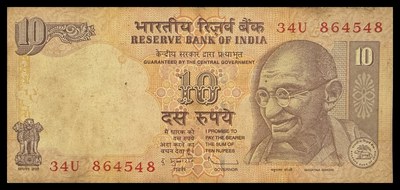
Mahatma Gandhi (1869–1948), leader of the Indian independence movement and pioneer of nonviolent resistance (satyagraha) against British colonial rule. Gandhi is universally honoured as the Father of the Nation in India and appears on all modern Indian rupee banknotes issued since 1996. The note features the Ashoka Pillar emblem of India at left, with the promise to pay text in Hindi and English, and Gandhi's portrait derived from a photograph taken in the 1940s.
Back
Indian wildlife trinity: an Asian elephant (Elephas maximus), Indian rhinoceros (Rhinoceros unicornis), and Bengal tiger (Panthera tigris tigris). These three species represent India's rich biodiversity and wildlife heritage, all native to the Indian subcontinent. The design emphasizes conservation and India's natural heritage. The denomination is repeated in 15 languages on the left panel in the language panel, representing India's linguistic diversity.
History
The Mahatma Gandhi Series was introduced by the Reserve Bank of India in 1996, replacing earlier portrait series. This design marks a significant shift in Indian currency, standardizing Gandhi's portrait across all denominations while featuring diverse themes on the reverse. The 10 rupee note has remained a workhorse denomination in daily Indian commerce. The wildlife reverse design emphasizes India's commitment to conservation of endangered species, all three animals being listed under various protection schemes.
Linked specimens (1)
Merge into another type
Repoints every linked specimen above to the chosen target type, fills any target nulls from this type, then deletes this type. This cannot be undone.