Type details
| Country | Indonesia |
| Currency | IDR |
| Denomination | 50 |
| Series | 1964 Series |
| Series year | 1964 |
| Series range | 1964-1968 |
| Issue year | 1964 |
| Issuer | Bank Indonesia |
| Issuer (native) | Bank Indonesia |
| Signatures | Gubernur: signature present; Direktur: signature present |
| Printer | Perum Perjetakan Kebajoran (P.N. Pertjetakan Kebajoran) |
| Reverse subject | Traditional Indonesian textile weaver |
| Themes | indigenous_culture,agriculture,architecture |
| Watermark | Garuda Pancasila emblem in clear field at right on back |
| Security features | watermark,microprint,intaglio |
| Colour palette | #d4c5a0,#6b5f4d,#8b7355 |
| Material | paper |
| Dimensions (mm) | 162x80 |
| Language / script | Latin |
| Languages | id |
| Pick # | P-95 |
| Rarity | common |
| Legal status | demonetized |
| Legal status date | 1968 |
| Predecessor currency | Rupiah (old series) |
| Successor currency | Rupiah (1968 series) |
| Era | 1946_1989 |
| Default value (low) | 2.0 |
| Default value (high) | 8.0 |
| Value currency | USD |
Front
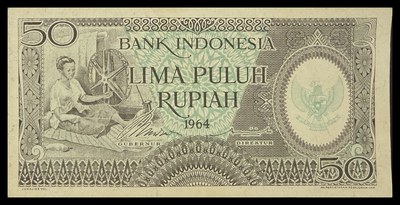
Traditional Indonesian village scene depicting thatched-roof houses (rumah adat) with palm trees in a rural mountainous landscape. This vignette represents traditional Indonesian architecture and rural life, showing stilted structures characteristic of vernacular building styles found across the archipelago. The scene emphasizes Indonesia's agricultural heritage and traditional village communities.
Back
Traditional Indonesian woman weaving on a hand loom, representing the nation's rich textile heritage. Indonesia has centuries-old traditions of textile production including batik, ikat, and songket weaving, which remain culturally significant crafts. The weaver is shown with a traditional spinning wheel and loom, symbolizing domestic industry and the preservation of indigenous craftsmanship in post-independence Indonesia.
History
This note belongs to the 1964 series issued by Bank Indonesia during the Sukarno era, a period of economic instability and inflation. The series featured scenes of traditional Indonesian life, agriculture, and culture, emphasizing national identity and indigenous heritage following independence. The rupiah underwent significant devaluation during this period, leading to currency reform in 1965-1966. This series was replaced by the 1968 series following the transition to the New Order government under Suharto. The notes were printed domestically at Perum Perjetakan Kebajoran in Jakarta.
Linked specimens (1)
Merge into another type
Repoints every linked specimen above to the chosen target type, fills any target nulls from this type, then deletes this type. This cannot be undone.