Type details
| Country | Indonesia |
| Currency | IDR |
| Denomination | 1000 Rupiah |
| Series | Issue of 1960 |
| Series year | 1960 |
| Series range | 1960–1964 |
| Issuer | Bank Indonesia |
| Signatures | Gubernur: Loekman Hakim; Direktur: T.E.H. Soedarjo |
| Printer | Pertjetakan Kebajoran |
| Engraver | Junalies Del |
| Reverse subject | Traditional Indonesian weaving (woman at loom) |
| Themes | agriculture,indigenous_culture,industry |
| Security features | microprint,intaglio |
| Colour palette | #d4c5a0,#4a5f7a,#8b9c6e |
| Material | paper |
| Dimensions (mm) | 178x88 |
| Language / script | Latin |
| Languages | id |
| Pick # | P-60 |
| Rarity | common |
| Legal status | demonetized |
| Legal status date | 1964 |
| Predecessor currency | Rupiah (1949 series) |
| Successor currency | Rupiah (1964 series) |
| Era | 1946_1989 |
| Default value (low) | 5.0 |
| Default value (high) | 15.0 |
| Value currency | USD |
Front
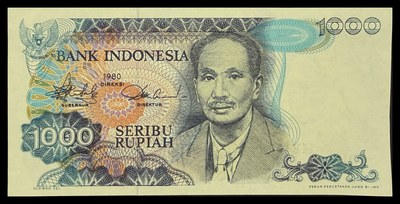
Terraced rice paddies (sawah) in mountainous terrain, depicting Indonesia's traditional agricultural landscape. The terracing system represents centuries-old farming practices in Java and other Indonesian islands, essential to the nation's rice cultivation and food security. This design celebrates Indonesia's agricultural heritage and the importance of rice farming to Indonesian society and economy.
Back
Traditional Indonesian weaving (woman at loom). A woman is shown operating a traditional Indonesian weaving loom, representing the nation's rich textile heritage including batik and songket production. This scene honors the artisanal crafts and indigenous textile traditions that are central to Indonesian cultural identity across the archipelago, particularly in regions like Java, Sumatra, and Bali.
History
Issue of 1960 series, part of the early Republic of Indonesia banknotes following independence. This series was issued during the period of Guided Democracy under President Sukarno. These notes circulated during a period of economic instability and were eventually replaced by the 1964 series as Indonesia struggled with inflation. The denomination of 1000 Rupiah was significant at the time. Printed domestically by Pertjetakan Kebajoran (Kebajoran Press), reflecting Indonesia's efforts to establish independent currency production capacity. The series featured themes of Indonesian agriculture, culture, and national development.
Linked specimens (1)
Merge into another type
Repoints every linked specimen above to the chosen target type, fills any target nulls from this type, then deletes this type. This cannot be undone.