Type details
| Country | Indonesia |
| Currency | IDR |
| Denomination | 10000 |
| Series | 1985 Series |
| Series year | 1985 |
| Series range | 1985–1992 |
| Issue year | 1985 |
| Issuer | Bank Indonesia |
| Issuer (native) | Bank Indonesia |
| Signatures | Gubernur: Arifin M. Siregar; Direktur: Sudirno |
| Printer | Perum Peruri (Percetakan Uang Republik Indonesia) |
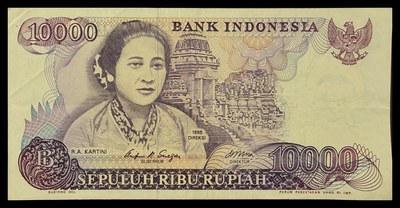
| Front portrait | R.A. Kartini |
| Reverse subject | Traditional Javanese house (rumah adat) |
| Themes | statesman,indigenous_culture,architecture |
| Watermark | Portrait of R.A. Kartini in clear field at left |
| Security features | watermark,security_thread,microprint,intaglio |
| Colour palette | #d4c8a0,#8b4513,#6b4423 |
| Material | paper |
| Dimensions (mm) | 156x68 |
| Language / script | Latin |
| Languages | id |
| Pick # | P-126b |
| Rarity | common |
| Legal status | demonetized |
| Legal status date | 1992 |
| Era | 1946_1989 |
| Default value (low) | 2.0 |
| Default value (high) | 8.0 |
| Value currency | USD |
Front
Traditional Javanese house (rumah adat) with distinctive raised roof architecture and decorative panels, surrounded by tropical vegetation. This architectural style represents Indonesian vernacular building traditions, particularly from Java, and emphasizes the nation's cultural heritage. The intricate guilloche patterns and ornamental borders showcase traditional Indonesian design motifs.
Back
Raden Ajeng Kartini (1879–1904), Indonesian national heroine and pioneer of women's rights and education for native Indonesians during Dutch colonial rule. Behind her portrait is Candi Kalasan, a Buddhist temple built in the 8th century during the Sailendra dynasty in Central Java. Kartini's legacy as an advocate for indigenous education and women's emancipation made her one of Indonesia's most honored figures on banknotes. The Garuda Pancasila emblem appears at upper right.
History
This note belongs to the 1985 Series issued by Bank Indonesia during the New Order period under President Suharto. The series featured Indonesian national heroes and cultural landmarks, emphasizing national identity and heritage. The 10,000 rupiah denomination was a high-value note at the time of issue. R.A. Kartini was chosen to represent the advancement of women's rights and education in Indonesian society. The series was gradually withdrawn in the early 1990s as newer security features became necessary. Notes were printed domestically by Perum Peruri, Indonesia's state printing company.
Linked specimens (1)
Merge into another type
Repoints every linked specimen above to the chosen target type, fills any target nulls from this type, then deletes this type. This cannot be undone.