Type details
| Country | Indonesia |
| Currency | IDR |
| Denomination | 100 Rupiah |
| Series | 1992 Series |
| Series year | 1992 |
| Series range | 1992–1999 |
| Issue year | 1992 |
| Issuer | Bank Indonesia |
| Issuer (native) | Bank Indonesia |
| Signatures | Direktur: illegible; Gubernur: illegible |
| Printer | Perum Peruri |
| Reverse subject | Pinisi sailing ship |
| Themes | architecture,transport,indigenous_culture |
| Watermark | Garuda Pancasila at center |
| Security features | watermark,microprint |
| Colour palette | #8b7355,#a0522d,#2f4f2f |
| Material | paper |
| Dimensions (mm) | 141x68 |
| Language / script | Latin |
| Languages | id |
| Pick # | 127h |
| Rarity | common |
| Legal status | demonetized |
| Legal status date | 1999 |
| Era | 1990_present |
| Default value (low) | 1.0 |
| Default value (high) | 3.0 |
| Value currency | USD |
Front
Traditional Indonesian Rumah Gadang (Great House) of the Minangkabau people from West Sumatra. These distinctive houses feature dramatically upward-curving roof peaks resembling buffalo horns, representing the matrilineal Minangkabau culture; they serve as family homes and are emblematic of Indonesian architectural heritage. The note includes Indonesian text warning against counterfeiting.
Back
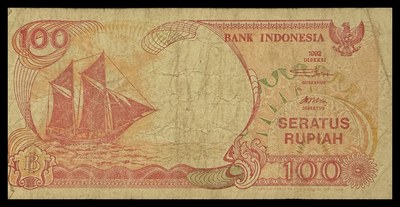
Pinisi sailing ship, a traditional two-masted wooden vessel built by the Konjo people of South Sulawesi. These ships are renowned for their craftsmanship and have been used for inter-island trade throughout the Indonesian archipelago for centuries; they remain symbols of Indonesia's maritime heritage and seafaring traditions. The Garuda Pancasila national emblem appears at upper right.
History
This note belongs to the 1992 series issued by Bank Indonesia, which featured traditional Indonesian cultural motifs and architecture. The 100 Rupiah denomination was part of the lower-value notes in circulation during the 1990s. The series was withdrawn and replaced following the Asian Financial Crisis of 1997-1998, with new designs introduced in 1999. This series emphasized Indonesia's diverse cultural heritage through depictions of traditional houses and maritime vessels from different regions of the archipelago.
Linked specimens (1)
Merge into another type
Repoints every linked specimen above to the chosen target type, fills any target nulls from this type, then deletes this type. This cannot be undone.