Type details
| Country | Indonesia |
| Currency | IDR |
| Denomination | 1000 |
| Series year | 1964 |
| Issue year | 1964 |
| Issuer | Bank Indonesia |
| Signatures | Gubernur: signature present; Direktur: signature present |
| Printer | Pertjetakan Kebajoran |
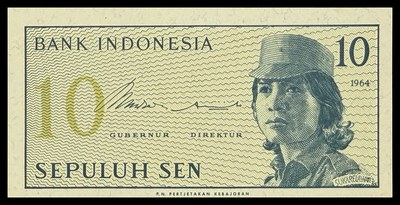
| Reverse subject | Indonesian woman in traditional dress |
| Themes | indigenous_culture,wildlife |
| Security features | microprint,intaglio |
| Colour palette | #d4c89a,#8fb4a4,#e8a89a |
| Material | paper |
| Language / script | Latin |
| Languages | id |
| Pick # | 98 |
| Rarity | scarce |
| Legal status | demonetized |
| Era | 1946_1989 |
| Default value (low) | 15.0 |
| Default value (high) | 35.0 |
| Value currency | USD |
Front
Anoa (Bubalus depressicornis), an endemic dwarf buffalo native to Sulawesi, Indonesia. The anoa is one of the smallest wild cattle species in the world and is critically endangered. The note depicts the animal in its natural mountainous forest habitat, with Banda Neira visible in the background vignette — a reference to the Banda Islands in the Maluku archipelago, historically important in the spice trade. The anoa represents Indonesia's unique wildlife heritage.
Back
Indonesian woman in traditional dress and headwear, representing the cultural diversity of the Indonesian archipelago. The portrait emphasizes indigenous culture and national identity during the Sukarno era. The back features signatures of the Governor (Gubernur) and Director (Direktur) of Bank Indonesia, with 'Sepuluh Sen' (Ten Sen) denomination text, as this note was issued during Indonesia's currency redenomination period.
History
This 1000 rupiah note was issued in 1964 during the Sukarno presidency, a period of significant economic instability and hyperinflation in Indonesia. The note was printed domestically by Pertjetakan Kebajoran (Kebajoran Printing Works). The 1964 series was part of Indonesia's post-independence currency issues and was eventually withdrawn and demonetized as Indonesia underwent currency reforms to combat hyperinflation. The note represents a transitional period in Indonesian monetary history before the New Order era and subsequent currency stabilization.
Linked specimens (1)
Merge into another type
Repoints every linked specimen above to the chosen target type, fills any target nulls from this type, then deletes this type. This cannot be undone.