Type details
| Country | Iran |
| Currency | IRR |
| Denomination | 500 |
| Series | Post-Revolution series |
| Series range | 1982–present |
| Issuer | Central Bank of the Islamic Republic of Iran |
| Issuer (native) | بانک مرکزی جمهوری اسلامی ایران |
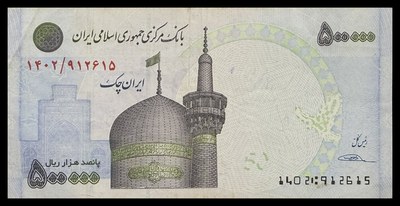
| Reverse subject | Imam Reza shrine |
| Themes | religion,architecture |
| Watermark | Emblem of Iran in clear field at right on back |
| Security features | thread,watermark,microprint,intaglio |
| Colour palette | #c8d4b8,#8b9d7a,#5a6b4a |
| Material | paper |
| Dimensions (mm) | 157x68 |
| Language / script | Persian/Farsi in Arabic script, English |
| Languages | fa,en |
| Pick # | 137 |
| Rarity | common |
| Legal status | in_circulation |
| Era | 1990_present |
| Default value (low) | 0.5 |
| Default value (high) | 2.0 |
| Value currency | USD |
Front
Garden entrance with ornate archway leading to tree-lined pathway, representing a traditional Persian garden motif. The design emphasizes natural beauty and the importance of gardens in Persian culture, which has been a recurring theme in Iranian banknote design following the Islamic Revolution of 1979.
Back
Imam Reza shrine in Mashhad, one of the holiest sites in Shia Islam and Iran's most important pilgrimage destination. The shrine complex houses the tomb of Ali al-Ridha (765–818 CE), the eighth Imam of Twelver Shia Islam, and has been a major pilgrimage site since the 9th century. The golden dome and minarets shown are iconic features of this sacred complex, which attracts millions of pilgrims annually.
History
This 500 rials note is part of the post-revolution Iranian currency series issued by the Central Bank of the Islamic Republic of Iran following the 1979 Islamic Revolution. The design reflects the new republic's emphasis on Islamic heritage and religious sites, departing from pre-revolutionary imagery. Iranian rials have experienced significant inflation over the decades, with the 500 rial note now representing minimal purchasing power. The note features Persian (Farsi) script in Arabic letters and uses traditional Islamic geometric patterns in its design elements.
Linked specimens (1)
Merge into another type
Repoints every linked specimen above to the chosen target type, fills any target nulls from this type, then deletes this type. This cannot be undone.