1 Krone #29
Deutschösterreich overprint issue
(1919–1920)
· issued 1916
· P-49
· common
Type details
| Country | Austria |
| Currency | Krone |
| Denomination | 1 |
| Series | Deutschösterreich overprint issue |
| Series year | 1916 |
| Series range | 1919–1920 |
| Issue year | 1916 |
| Issuer | Austro-Hungarian Bank (with Deutschösterreich overprint) |
| Issuer (native) | Oesterreichisch-Ungarische Bank / Osztrák-Magyar Bank |
| Signatures | Generalrat-Főtanácsos; Gouverneur-Kormányzó; Generalsekretär-Vezértitkár |
| Printer | Austro-Hungarian Bank Printing Works |
| Reverse subject | Female head representing Austria (allegorical) |
| Themes | statesman,architecture |
| Security features | intaglio,microprint |
| Colour palette | #c94c4c,#f5f5dc,#2c2c2c |
| Material | paper |
| Dimensions (mm) | 120x64 |
| Language / script | Latin |
| Languages | de,hu,cs,sk,uk,it,sl,hr,sr,ro |
| Pick # | P-49 |
| Rarity | common |
| Legal status | demonetized |
| Legal status date | 1924 |
| Predecessor currency | Austro-Hungarian Krone |
| Successor currency | Austrian Schilling |
| Era | 1900_1945 |
| Default value (low) | 3.0 |
| Default value (high) | 8.0 |
| Value currency | USD |
Front
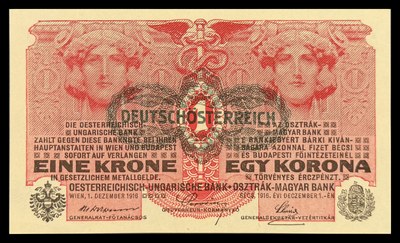
This 1 Krone note was originally issued by the Austro-Hungarian Bank on December 1, 1916, during World War I. The red 'DEUTSCHÖSTERREICH' overprint was applied in 1919 to distinguish Austrian currency from Hungarian issues following the dissolution of the Austro-Hungarian Empire. The note features the imperial Austrian double-headed eagle at left and the Hungarian coat of arms at right, reflecting the dual monarchy's bilingual administration with German text on the left and Hungarian on the right.
Back
The reverse displays an allegorical female head representing Austria at center, surrounded by Art Nouveau decorative elements. The denomination 'ONE KORUNA/KORONA' is shown in eight languages representing the various nationalities of the former Empire: Czech, Slovak, Ukrainian, Italian, Slovenian, Croatian, Serbian, and Romanian. Anti-counterfeiting warnings appear in German and Hungarian.
History
After Austria-Hungary's defeat in World War I and the empire's dissolution in November 1918, the newly proclaimed Republic of German-Austria (Deutschösterreich) overprinted existing Austro-Hungarian banknotes to differentiate them from those circulating in Hungary and the successor states. The 'Deutschösterreich' overprint was applied from early 1919. This transitional currency remained legal tender until the introduction of the Austrian Schilling in 1925. The note exemplifies the chaotic monetary conditions of post-WWI Central Europe.
Linked specimens (1)
Merge into another type
Repoints every linked specimen above to the chosen target type, fills any target nulls from this type, then deletes this type. This cannot be undone.