Type details
| Country | Kuwait |
| Currency | KWD |
| Denomination | 1 |
| Series | Third Issue |
| Series year | 1980 |
| Series range | 1980-1991 |
| Issue year | 1980 |
| Issuer | Central Bank of Kuwait |
| Issuer (native) | بنك الكويت المركزي |
| Signatures | Governor: Abdullatif Yousef Al-Hamad |
| Printer | De La Rue |
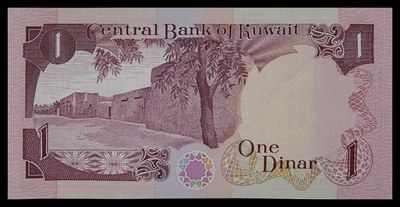
| Reverse subject | Seif Palace gate |
| Themes | architecture,maritime,indigenous_culture |
| Watermark | Falcon's head |
| Security features | thread,microprint,intaglio |
| Colour palette | #8b4d6b,#d4a5a5,#c9b18f |
| Material | paper |
| Dimensions (mm) | 140x66 |
| Language / script | Arabic,Latin |
| Languages | ar,en |
| Pick # | P-13 |
| Krause ID | KM#13 |
| Rarity | common |
| Legal status | withdrawn |
| Legal status date | 1991 |
| Predecessor currency | Kuwaiti Dinar (Second Issue) |
| Successor currency | Kuwaiti Dinar (Fourth Issue) |
| Era | 1990_present |
| Default value (low) | 5.0 |
| Default value (high) | 15.0 |
| Value currency | USD |
Front
Traditional Kuwaiti urban scene featuring historic mud-brick architecture and date palms, representing Old Kuwait before the oil era. The scene depicts the traditional quarter with palm trees in the foreground and characteristic fortress-like buildings of Kuwait's pre-modern commercial districts. The note includes decorative Islamic geometric patterns and the denomination 'One Dinar' in English with multicolored rosette security features.
Back
The national emblem of Kuwait showing a dhow sailing vessel on waves, flanked by two flags, representing Kuwait's maritime heritage and pearl-diving history. At left, the gate of Seif Palace (the historic seat of Kuwait's government, built in 1896 and named for the curved sword 'Seif'). Modern high-rise buildings are shown in the background, symbolizing Kuwait's development. The denomination appears in Arabic as 'دينار واحد' (one dinar).
History
Third Issue of Kuwaiti dinars, introduced in 1980 and circulated until 1991. This series was withdrawn following the Iraqi invasion of Kuwait (1990-1991), when occupying forces looted the Central Bank. After liberation, Kuwait demonetized the Third Issue to prevent stolen notes from circulating and introduced the Fourth Issue in 1991. The Third Issue notes are notable for their depiction of traditional Kuwaiti life contrasted with modern development, reflecting the nation's rapid transformation following oil wealth.