Type details
| Country | Kazakhstan |
| Currency | KZT |
| Denomination | 1 |
| Series | First tyin series |
| Series year | 1993 |
| Series range | 1993–1995 |
| Issue year | 1993 |
| Issuer | National Bank of Kazakhstan |
| Issuer (native) | Қазақстан Ұлттық Банкі |
| Reverse subject | State Emblem of Kazakhstan |
| Themes | statesman,architecture |
| Security features | microprint,intaglio |
| Colour palette | #d4d463,#8b7355,#6b8e23 |
| Material | paper |
| Dimensions (mm) | 105x52 |
| Language / script | Cyrillic, Latin |
| Languages | kk,ru |
| Pick # | 1a |
| Rarity | common |
| Legal status | demonetized |
| Legal status date | 1995-11-15 |
| Predecessor currency | Soviet ruble |
| Successor currency | Tenge |
| Era | 1990_present |
| Default value (low) | 0.5 |
| Default value (high) | 2.0 |
| Value currency | USD |
Front
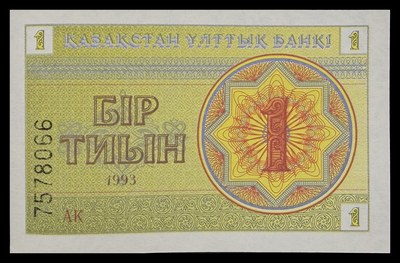
Ornamental design featuring traditional Kazakh decorative motifs with a stylized monument or architectural element at center within a circular rosette pattern. The denomination '1 ТИЫН' (1 tyin) is prominently displayed with the year 1993, reflecting the newly independent Republic of Kazakhstan's first national currency issue following the dissolution of the Soviet Union in 1991.
Back
State Emblem of Kazakhstan, adopted in 1992, featuring a shanyrak (the circular crown of a yurt) at center symbolizing the common home and unity of all peoples in Kazakhstan, flanked by mythical winged horses (tulpars) and a five-pointed star above. The emblem represents the new nation's identity and sovereignty, with the denomination '1 ТИЫН' repeated on this side.
History
The tyin was the first currency of independent Kazakhstan, introduced on November 15, 1993 to replace the Soviet ruble at par. This 1 tyin note is from the inaugural issue of the Republic of Kazakhstan as a sovereign state. The tyin circulated only briefly, as hyperinflation necessitated its replacement by the tenge on November 15, 1995 at a rate of 1 tenge = 500 tyin. These low-denomination notes saw heavy use during the transitional economic period and are now demonetized. The design incorporates traditional Kazakh ornamental patterns reflecting the nation's cultural heritage.