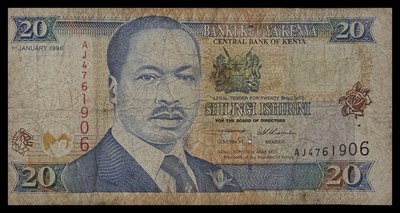
Type details
| Country | Kenya |
| Currency | KES |
| Denomination | 20 |
| Series | 1996 series |
| Series year | 1996 |
| Series range | 1996–2005 |
| Issue year | 1996 |
| Issuer | Central Bank of Kenya |
| Signatures | Governor: (signature illegible); Member: (signature illegible) |
| Front portrait | Daniel Toroitich arap Moi |
| Reverse subject | Moi International Sports Centre (Kasarani Stadium) |
| Themes | statesman,sport,architecture |
| Watermark | Lion's head in clear field at left |
| Security features | thread,microprint,intaglio |
| Colour palette | #8b7355,#4a5f8c,#d4a76a |
| Material | paper |
| Dimensions (mm) | 145x73 |
| Language / script | Latin |
| Languages | en,sw |
| Pick # | P-32a |
| Rarity | common |
| Legal status | withdrawn |
| Legal status date | 2005 |
| Era | 1990_present |
| Default value (low) | 2.0 |
| Default value (high) | 5.0 |
| Value currency | USD |
Front
Daniel Toroitich arap Moi (1924–2020), second President of the Republic of Kenya (1978–2002). Moi succeeded Jomo Kenyatta and served for 24 years, making him one of Africa's longest-serving leaders. The note bears the coat of arms of Kenya with two lions, crossed spears, and a shield with the national motto 'Harambee' (pulling together). Cotton plant motif appears at lower right.
Back
Moi International Sports Centre, commonly known as Kasarani Stadium, located in Nairobi. The facility was built in 1987 to host the 1987 All-Africa Games and is Kenya's largest stadium with a capacity of 60,000. The reverse shows the stadium's distinctive oval architecture with an athlete running and traditional musical instruments (nyatiti lyre) at left, symbolizing Kenya's sporting achievement and cultural heritage.
History
This 20 shilling note belongs to the 1996 series issued by the Central Bank of Kenya during the presidency of Daniel arap Moi, whose portrait appears on all denominations of this series. The series was introduced on 1 January 1996 and remained in circulation until being replaced by a new series in 2005. The banknotes of this era featured portraits of President Moi on the obverse and various national development projects and cultural themes on the reverse, emphasizing Kenya's post-independence progress and national identity.