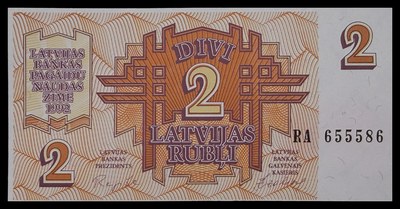
Type details
| Country | Latvia |
| Currency | LVR |
| Denomination | 2 |
| Series | First Rublis series |
| Series year | 1992 |
| Series range | 1992–1993 |
| Issue year | 1992 |
| Issuer | Bank of Latvia |
| Issuer (native) | Latvijas Banka |
| Themes | architecture,indigenous_culture |
| Security features | microprint,intaglio |
| Colour palette | #d4a574,#8b4513,#f5deb3 |
| Material | paper |
| Dimensions (mm) | 105x54 |
| Language / script | Latin |
| Languages | lv |
| Pick # | P-36 |
| Rarity | common |
| Legal status | demonetized |
| Legal status date | 1993-10-18 |
| Predecessor currency | Soviet Ruble |
| Successor currency | Latvian Lats |
| Era | 1990_present |
| Default value (low) | 1.0 |
| Default value (high) | 3.0 |
| Value currency | USD |
Front
Stylized ornamental design featuring traditional Latvian folk art patterns arranged in a geometric cross motif. The denomination '2 LATVIJAS RUBĻI' (2 Latvian Rubles) is displayed at center within decorative basketweave and geometric patterns characteristic of Latvian textile and wooden architecture traditions. Text on left reads 'LATVIJAS BANKAS PAGAIDU NAUDAS ZĪME 1992' (Temporary Currency Note of the Bank of Latvia 1992). This transitional currency represented Latvia's first step toward monetary independence after regaining sovereignty from the Soviet Union in 1991.
Back
Similar ornamental cross design with geometric folk patterns in brown and tan tones, featuring the denomination '2 LATVIJAS RUBĻI' at center. The design continues the theme of traditional Latvian decorative arts, particularly reflecting the wooden architecture and textile patterns that are integral to Latvian cultural heritage. The symmetric layout mirrors the front with denomination numerals in the corners.
History
The Latvian Rublis (plural: Rubļi) was introduced in May 1992 as a temporary transitional currency following Latvia's restoration of independence from the Soviet Union in 1991. This series served as 'pagaidu naudas zīme' (temporary currency notes) to replace the Soviet Ruble and establish monetary sovereignty. The notes circulated for only 16 months before being replaced by the reintroduced Latvian Lats on October 18, 1993, at a rate of 1 Lats = 200 Rubļi. The 2 Rublis denomination was one of the lower values in the series. The design deliberately avoided Soviet-era imagery, instead drawing on traditional Latvian folk art motifs to assert national identity.