5 Lebanese Pound (Livre) #300
First series (Independence)
(1964–1986)
· 62
· common
Type details
| Country | Lebanon |
| Currency | Lebanese Pound (Livre) |
| Denomination | 5 |
| Series | First series (Independence) |
| Series range | 1964–1986 |
| Issuer | Banque du Liban |
| Issuer (native) | مصرف لبنان |
| Printer | Thomas de la Rue & Company Limited |
| Reverse subject | Roman stone bridge at Nahr el-Kalb (Dog River) |
| Themes | architecture,transport |
| Watermark | Cedar tree in clear field at left |
| Security features | microprint,intaglio |
| Colour palette | #5a7a5a,#b8c8b8,#2d4a2d |
| Material | paper |
| Dimensions (mm) | 158x76 |
| Language / script | Arabic, Latin |
| Languages | ar,fr,en |
| Pick # | 62 |
| Rarity | common |
| Legal status | withdrawn |
| Legal status date | 1986 |
| Predecessor currency | Syrian Pound |
| Era | 1946_1989 |
| Default value (low) | 5.0 |
| Default value (high) | 15.0 |
| Value currency | USD |
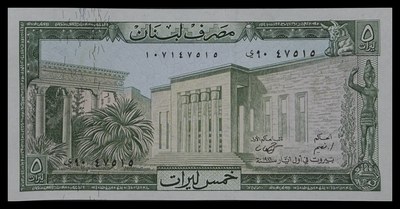
Front
The Crusader-era fortifications at Byblos (Jbeil), one of the oldest continuously inhabited cities in the world and a UNESCO World Heritage site. The archaeological complex includes Phoenician temples, Roman colonnades, and the prominent Crusader castle built in the 12th century. This ancient port city was a major center of Phoenician civilization and the source of the Greek word for book (biblos). Palm trees frame the architectural ensemble, emphasizing Lebanon's Mediterranean heritage.
Back
Roman stone bridge spanning the Nahr el-Kalb (Dog River) near Beirut. This historic river crossing has been a strategic military and commercial route for millennia, with commemorative steles carved by ancient conquerors from Ramesses II to modern armies. The stone bridge depicted shows the classical Roman arch construction that has endured for centuries, set against the dramatic gorge where the river meets the Mediterranean coast.
History
This note belongs to the first series issued by Banque du Liban following Lebanese independence, printed by Thomas de la Rue from 1964 to 1986. The series emphasized Lebanon's ancient heritage and archaeological treasures, positioning the new nation as heir to Phoenician, Roman, and medieval civilizations. The 5 Livres denomination was a basic circulating note during Lebanon's economic boom period before the civil war (1975–1990). These notes were gradually replaced in the late 1980s as hyperinflation necessitated higher denominations and new security features.
Linked specimens (1)
Merge into another type
Repoints every linked specimen above to the chosen target type, fills any target nulls from this type, then deletes this type. This cannot be undone.