Type details
| Country | Lebanon |
| Currency | LBP |
| Denomination | 1000 |
| Series | Post-Civil War series |
| Series year | 1990 |
| Series range | 1990–present |
| Issuer | Banque du Liban |
| Issuer (native) | مصرف لبنان |
| Printer | Giesecke+Devrient |
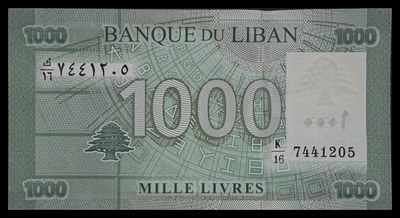
| Front portrait | Cedar of Lebanon |
| Reverse subject | Ruins of Baalbek |
| Themes | architecture,indigenous_culture |
| Watermark | Cedar of Lebanon in clear field at right |
| Security features | thread,microprint,intaglio,latent_image |
| Colour palette | #6b8e7d,#d4c8a8,#4a5f52 |
| Material | paper |
| Dimensions (mm) | 155x77 |
| Language / script | Latin, Arabic |
| Languages | fr,ar |
| Pick # | P-84 |
| Rarity | common |
| Legal status | in_circulation |
| Predecessor currency | Lebanese Livre (old series, pre-1990) |
| Era | 1990_present |
| Default value (low) | 2.0 |
| Default value (high) | 8.0 |
| Value currency | USD |
Front
The Cedar of Lebanon (Cedrus libani), Lebanon's national emblem featured in the center of the country's flag and coat of arms, symbolizing holiness, eternity and peace. The cedar has been a symbol of Lebanon since ancient times, mentioned in the Epic of Gilgamesh and the Bible, and historically prized for construction of temples and ships across the Mediterranean world.
Back
Ruins of Baalbek (ancient Heliopolis), one of the finest examples of Imperial Roman architecture and among the best preserved Roman ruins in Lebanon. The site features the temples of Jupiter, Bacchus, and Venus, built during the 1st-3rd centuries CE on earlier Phoenician foundations. Baalbek is a UNESCO World Heritage Site and represents Lebanon's rich Greco-Roman heritage.
History
This 1000 Livres note belongs to the modern series of Lebanese banknotes issued by Banque du Liban after the Lebanese Civil War (1975-1990). The series emphasizes Lebanon's cultural heritage through architectural motifs and national symbols. The denomination was issued during a period of currency instability and inflation in Lebanon's post-war economy. The note features both French ('MILLE LIVRES') and Arabic text, reflecting Lebanon's bilingual administrative tradition.
Linked specimens (1)
Merge into another type
Repoints every linked specimen above to the chosen target type, fills any target nulls from this type, then deletes this type. This cannot be undone.