Type details
| Country | Burundi |
| Currency | BIF |
| Denomination | 10 |
| Series | 2007 issue |
| Series year | 2007 |
| Series range | 2007-2015 |
| Issue year | 2007 |
| Issuer | Banque de la République du Burundi |
| Issuer (native) | Ibanki ya Republika y'Uburundi |
| Reverse subject | Traditional Burundian basket weaving pattern |
| Themes | indigenous_culture,agriculture |
| Watermark | National coat of arms of Burundi in clear field at center |
| Security features | watermark,microprint,intaglio |
| Colour palette | #6b8e7e,#f5f5dc,#2d5c4a |
| Material | paper |
| Dimensions (mm) | 145x72 |
| Language / script | Latin |
| Languages | fr,rn |
| Pick # | 33e |
| Rarity | common |
| Legal status | withdrawn |
| Legal status date | 2015 |
| Era | 1990_present |
| Default value (low) | 1.0 |
| Default value (high) | 3.0 |
| Value currency | USD |
Front
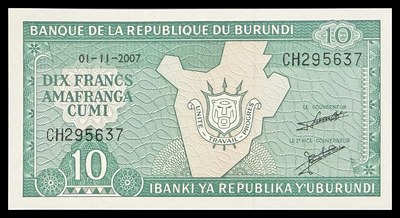
The coat of arms of Burundi centered on a map outline of the country. The national emblem features a shield with the head of a lion, three spears, and the national motto 'Unité-Travail-Progrès' (Unity-Work-Progress) in French. The coat of arms was adopted in 1966 and represents the Republic's sovereignty and commitment to national unity and development. The map outline emphasizes Burundi's territorial identity as one of Africa's smallest landlocked nations in the Great Lakes region.
Back
Traditional Burundian basket weaving pattern representing indigenous craftsmanship and cultural heritage. The geometric circular design reflects the intricate coiled basketry techniques practiced by Burundian artisans, particularly among Tutsi and Hutu communities. These baskets (called 'agaseke') are symbolic of peace, protection, and hospitality in Burundian culture, and the weaving tradition has been recognized by UNESCO. The design emphasizes the national values of unity, work, and progress through cultural preservation.
History
This note is from the 2007 issue of Burundian franc banknotes, part of a series that circulated from 2007 until being replaced by new designs in 2015. The banknotes of this series featured the national coat of arms and emphasized Burundian cultural themes. The Burundian franc has been the country's currency since 1964, following independence from Belgian colonial rule in 1962. This 10 franc denomination represents a low-value note in a country that experienced significant inflation over the decades, though it remained legal tender throughout the 2000s.
Linked specimens (1)
Merge into another type
Repoints every linked specimen above to the chosen target type, fills any target nulls from this type, then deletes this type. This cannot be undone.