Type details
| Country | Mexico |
| Currency | MXN |
| Denomination | 50 |
| Series | Type D Polymer Series |
| Series range | 2004-present |
| Issuer | Banco de México |
| Front portrait | José María Morelos y Pavón |
| Reverse subject | Aqueduct of Morelia |
| Themes | statesman,military,architecture,wildlife |
| Security features | hologram,see_through_register,optically_variable_ink,microprint,uv |
| Colour palette | #d4a5a5,#f5deb3,#8b4513 |
| Material | polymer |
| Dimensions (mm) | 128x66 |
| Language / script | Latin |
| Languages | es |
| Pick # | 123 |
| Rarity | common |
| Legal status | in_circulation |
| Predecessor currency | Mexican Peso (old) |
| Era | 1990_present |
| Default value (low) | 2.0 |
| Default value (high) | 5.0 |
| Value currency | USD |
Front
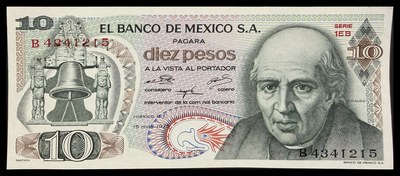
José María Morelos y Pavón (1765–1815), Mexican Roman Catholic priest and revolutionary rebel leader who led the Mexican War of Independence after Miguel Hidalgo's execution. A key military and political figure of the independence movement, he organized the Congress of Chilpancingo in 1813, which declared Mexican independence. The note features monarch butterflies (Danaus plexippus) which migrate annually to the mountains of Michoacán state where Morelos was born, representing the natural heritage of his home region. The inscription 'ACUEDUCTO DE MORELIA, MICH.' references the colonial aqueduct in Morelia (formerly Valladolid), the capital city of Michoacán renamed in Morelos's honor.
Back
The Morelia Aqueduct (Acueducto de Morelia) in Michoacán, a colonial-era structure built between 1785 and 1789 to supply water to the city. The aqueduct features 253 arches and stands as one of the most important examples of colonial hydraulic engineering in Mexico. The back also depicts the Bell of Dolores (Campana de Dolores) flanked by pre-Columbian Atlante figures, symbolizing the call to independence issued by Miguel Hidalago in 1810. The bell now hangs in the National Palace in Mexico City and is rung annually on Independence Day.
History
This 50-peso polymer note is part of Mexico's Type D series introduced beginning in 2004, featuring a transition from paper to polymer substrate for enhanced durability and security. The series honors heroes of Mexican independence and revolution. The 50-peso denomination specifically commemorates José María Morelos, who is considered the greatest military leader of the independence movement after Hidalgo. The monarch butterfly motif references the Monarch Butterfly Biosphere Reserve in Michoacán, a UNESCO World Heritage site. The visible serial number format (SERIE 1EB, B4 34 / 2) represents the Bank of Mexico's standard alpha-numeric series coding introduced with polymer notes. The note remains legal tender and is widely circulated.
Linked specimens (1)
Merge into another type
Repoints every linked specimen above to the chosen target type, fills any target nulls from this type, then deletes this type. This cannot be undone.