Type details
| Country | Mongolia |
| Currency | Mongolian Tögrög |
| Denomination | 50 |
| Series range | 1993–2000 |
| Issuer | Bank of Mongolia |
| Issuer (native) | Монголбанк |
| Front portrait | Damdiny Sükhbaatar |
| Reverse subject | Traditional Mongolian agricultural scene with oxen plowing |
| Themes | statesman,military,agriculture |
| Security features | microprint,intaglio |
| Colour palette | #d4c5a0,#4a4a5e,#c65d5d |
| Material | paper |
| Dimensions (mm) | 120x60 |
| Language / script | Mongolian Cyrillic |
| Languages | mn |
| Pick # | 54 |
| Rarity | common |
| Legal status | withdrawn |
| Legal status date | 2000 |
| Predecessor currency | Soviet-era Tögrög |
| Era | 1990_present |
| Default value (low) | 1.0 |
| Default value (high) | 3.0 |
| Value currency | USD |
Front
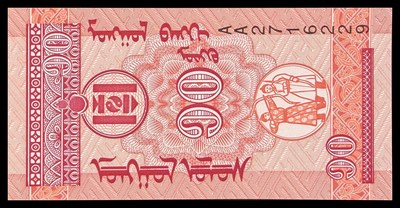
Damdiny Sükhbaatar (1893–1923), founding father of the Mongolian People's Republic and leader of the Mongolian Revolution of 1921. A military hero who liberated Mongolia from Chinese occupation and established independence, Sükhbaatar is one of the most revered figures in modern Mongolian history. His portrait appears within a circular medallion, depicted in traditional military attire. The inscription 'МОНГОЛБАНК' (Bank of Mongolia) appears vertically along the left margin, with '50 ТӨГРӨГ' (50 Tögrög) prominently displayed.
Back
Traditional Mongolian agricultural scene depicting oxen-drawn plowing, representing the pastoral and agricultural heritage of Mongolia. The scene shows two oxen harnessed to a plow with a farmer, symbolizing the importance of agriculture in Mongolian life and economy. The denomination '50' appears centrally within ornamental guilloché patterns, with Mongolian script inscriptions including the currency name. This imagery reflects Mongolia's transition period in the 1990s while honoring traditional lifestyles.
History
This 50 Tögrög note belongs to the first series issued by the independent Bank of Mongolia following the democratic revolution of 1990 and the dissolution of the Mongolian People's Republic in 1992. The series was introduced in 1993 as part of Mongolia's economic transition from a Soviet-aligned planned economy to a market economy. The note features the traditional color scheme and design elements of early post-Soviet Mongolian currency. Sükhbaatar has appeared on Mongolian currency since 1925, reflecting his enduring status as the nation's founding revolutionary hero. This series was gradually replaced by redesigned notes beginning in the late 1990s and was fully withdrawn from circulation by 2000. The note's modest denomination and paper substrate are characteristic of Mongolia's economic challenges during the difficult transition period of the 1990s.
Linked specimens (1)
Merge into another type
Repoints every linked specimen above to the chosen target type, fills any target nulls from this type, then deletes this type. This cannot be undone.