Type details
| Country | Myanmar |
| Currency | Kyat |
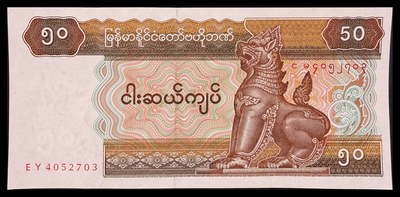
| Denomination | 50 |
| Series range | 1994–present |
| Issuer | Central Bank of Myanmar |
| Issuer (native) | မြန်မာနိုင်ငံတော်ဗဟိုဘဏ် |
| Printer | Security Printing Works, Myanmar |
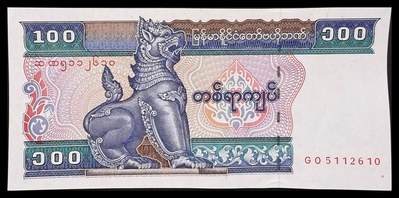
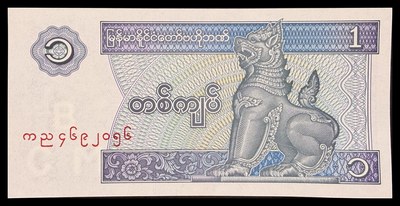
| Reverse subject | Chinthe (mythological lion guardian) |
| Themes | indigenous_culture,mythology |
| Watermark | Chinthe (Burmese lion-dragon) in clear field at left |
| Security features | microprint,intaglio |
| Colour palette | #d4a574,#8b7355,#e8d5c4 |
| Material | paper |
| Dimensions (mm) | 145x70 |
| Language / script | Burmese |
| Languages | my,en |
| Pick # | 73 |
| Rarity | common |
| Legal status | in_circulation |
| Era | 1990_present |
| Default value (low) | 1.0 |
| Default value (high) | 5.0 |
| Value currency | USD |
Front
Traditional Burmese lacquerware artisan scene depicting craftspeople at work creating traditional lacquerware bowls and vessels. Lacquerware (known as yun in Burmese) is one of Myanmar's most celebrated traditional crafts, centered historically in Bagan and Pagan, with techniques passed down for centuries. The scene shows artisans engaged in the meticulous process of applying, decorating, and finishing lacquer pieces, representing Myanmar's rich cultural heritage and artisan traditions.
Back
Chinthe (also spelled chinthe or chinthé), the mythological lion-like guardian creature from Burmese Buddhist tradition. The chinthe is a protective deity commonly found flanking entrances to pagodas, temples, and important buildings throughout Myanmar. This leonine figure combines features of a lion and dragon, and serves as a guardian symbol deeply embedded in Myanmar's religious and cultural iconography. The chinthe has been a national symbol and appears on various denominations of Myanmar kyat banknotes.
History
This 50 kyat note belongs to the series introduced by the Central Bank of Myanmar (formerly Burma) in 1994 following the country's economic reforms. The design emphasizes traditional Burmese cultural motifs rather than political figures, featuring artisan crafts on the front and the protective chinthe on the reverse. The serial number format with prefix 'G' followed by eight digits is consistent with Central Bank of Myanmar printing practices from the 1990s onward. These notes remain legal tender and are among the most common low-denomination Myanmar banknotes in circulation. The kyat has been Myanmar's currency since 1952, replacing the Burmese rupee.
Linked specimens (3)
Merge into another type
Repoints every linked specimen above to the chosen target type, fills any target nulls from this type, then deletes this type. This cannot be undone.