Type details
| Country | Myanmar |
| Currency | Kyat |
| Denomination | 20 |
| Series | 1994 series |
| Series range | 1994–1998 |
| Issuer | Central Bank of Myanmar |
| Issuer (native) | မြန်မာနိုင်ငံတော်ဗဟိုဘဏ် |
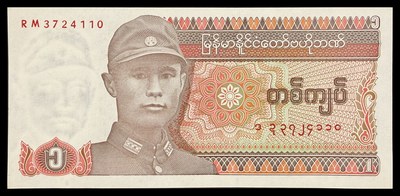
| Front portrait | Chinthe |
| Reverse subject | General Aung San |
| Themes | mythology,military,statesman,indigenous_culture |
| Watermark | Chinthe (mythical lion) in clear field |
| Security features | microprint,intaglio |
| Colour palette | #8fbc8f,#d2b48c,#cd5c5c |
| Material | paper |
| Dimensions (mm) | 140x67 |
| Language / script | Burmese (Myanmar) |
| Languages | my |
| Pick # | P-72 |
| Rarity | common |
| Legal status | withdrawn |
| Legal status date | 1998 |
| Era | 1990_present |
| Default value (low) | 1.0 |
| Default value (high) | 3.0 |
| Value currency | USD |
Front
Chinthe (or Leogryph), a mythical guardian lion-like creature from Burmese mythology. The chinthe is a protective symbol derived from the Sanskrit siṃha (lion), ubiquitous in Burmese temple and pagoda architecture, and serves as a national emblem of Myanmar. Pairs of chinthes traditionally guard entrances to Buddhist temples throughout the country.
Back
General Aung San (1915–1947), Burmese revolutionary, nationalist, and founder of the modern Tatmadaw (Myanmar Armed Forces). He negotiated Burma's independence from Britain but was assassinated in July 1947, months before independence was achieved. Widely revered as the father of modern Myanmar, he is honored on multiple denominations of Myanmar banknotes.
History
This 20 Kyat note belongs to the 1994 series issued by the Central Bank of Myanmar (formerly Union of Burma Bank). The series was introduced following the 1989 demonetization that replaced earlier kyat notes. The 1994 series circulated until approximately 1998 when newer security-enhanced designs were introduced. Myanmar kyat notes of this era featured traditional Burmese iconography including the chinthe, which appears prominently on multiple denominations. The Burmese script text identifies the issuer and denomination. The note uses traditional engraved intaglio printing with guilloche patterns typical of 1990s Southeast Asian banknote design.
Linked specimens (1)
Merge into another type
Repoints every linked specimen above to the chosen target type, fills any target nulls from this type, then deletes this type. This cannot be undone.