Type details
| Country | Myanmar |
| Currency | MMK |
| Denomination | 10 |
| Series range | 1973-present |
| Issuer | Central Bank of Myanmar |
| Issuer (native) | ဗဟိုဘဏ် |
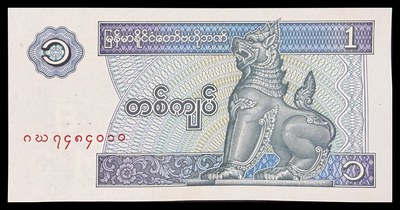
| Reverse subject | Chinthe (Burmese leogryph) |
| Themes | mythology,architecture |
| Watermark | Chinthe head in clear field at left |
| Security features | microprint,intaglio |
| Colour palette | #e8d5c8,#a67ba8,#7ba8c8 |
| Material | paper |
| Dimensions (mm) | 130x65 |
| Language / script | Burmese script |
| Languages | my,en |
| Pick # | 71 |
| Rarity | common |
| Legal status | in_circulation |
| Era | 1990_present |
| Default value (low) | 0.5 |
| Default value (high) | 2.0 |
| Value currency | USD |
Front
The Karaweik Palace, a royal barge-shaped replica of a Burmese royal barge on Kandawgyi Lake in Yangon. Built in 1972–1974, this concrete structure serves as a restaurant and cultural venue, designed to resemble the royal barge (karaweik) of the Burmese monarchs and is one of Myanmar's most iconic modern architectural symbols, representing traditional Burmese royal grandeur.
Back
A chinthe, the mythical leogryph (lion-griffin hybrid) that serves as a protective guardian figure in Burmese Buddhist culture. Chinthes are traditionally placed in pairs at the entrances of pagodas and temples throughout Myanmar to ward off evil spirits; they are among the most ubiquitous symbols in Burmese religious and cultural iconography, representing strength and protection.
History
This 10 Kyat note is part of Myanmar's long-running series issued since 1973. The kyat has been Myanmar's currency since 1952, replacing the Burmese rupee. This particular design featuring the Karaweik Palace and chinthe has remained largely unchanged across multiple printings from the 1970s through the 1990s and beyond, issued under different political regimes (from socialist Burma to the State Law and Order Restoration Council/military junta period). Serial numbering on Myanmar notes does not encode issue years in a publicly documented manner, so precise dating requires cross-reference with signature combinations or documented print runs. The denomination remains in active circulation as a low-value note.
Linked specimens (1)
Merge into another type
Repoints every linked specimen above to the chosen target type, fills any target nulls from this type, then deletes this type. This cannot be undone.