Type details
| Country | Myanmar |
| Currency | MMK |
| Denomination | 5 Kyats |
| Series range | 1973-present |
| Issuer | Central Bank of Myanmar |
| Reverse subject | Karaweik Hall |
| Themes | agriculture,architecture,indigenous_culture |
| Security features | intaglio,microprint |
| Colour palette | #d4b896,#8b4513,#e6d5c3 |
| Material | paper |
| Dimensions (mm) | 130x65 |
| Language / script | Latin,Burmese |
| Languages | en,my |
| Pick # | 57 |
| Rarity | common |
| Legal status | withdrawn |
| Era | 1990_present |
| Default value (low) | 0.5 |
| Default value (high) | 2.0 |
| Value currency | USD |
Front
Agricultural scene depicting farmers plowing a rice field with oxen beneath a tree. This vignette represents Myanmar's foundational agricultural economy, with rice cultivation being the backbone of the nation's rural life and a symbol of traditional farming practices that have sustained the country for centuries. The imagery honors the labour of Myanmar's farming communities.
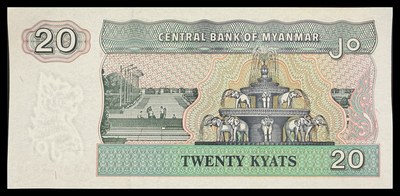
Back
Karaweik Hall (Karaweik Palace), a royal barge-shaped ceremonial structure on the eastern shore of Kandawgyi Lake in Yangon. Built in 1974, the hall is designed to resemble the royal karaweik (a mythical bird from Buddhist cosmology) and serves as a restaurant and cultural venue. The structure is flanked by the ornamental steps and pavilions of Kandawgyi Gardens, representing Myanmar's architectural heritage and Buddhist cultural traditions. The hall's distinctive tiered roof and elephant sculptures at its base are iconic symbols of Burmese craftsmanship.
History
This 5 Kyats note belongs to the series introduced by the Central Bank of Myanmar (formerly Burma) after 1989, when the country's name was officially changed from Burma to Myanmar. The note features the English inscription 'Central Bank of Myanmar' and denomination in both English and Burmese script. The 5 Kyat denomination was part of Myanmar's decimal currency system established in 1952, replacing the rupee. This particular design with the agricultural scene and Karaweik Hall has been used across multiple printings from the 1970s through the 1990s. The note was eventually demonetized as Myanmar experienced significant currency reforms and redenominations. Pick number P-57 corresponds to notes from the 1973 series onward with this design. The lack of visible year or signature makes precise dating difficult, but the design elements and issuer name place it in the post-1989 period.
Linked specimens (1)
Merge into another type
Repoints every linked specimen above to the chosen target type, fills any target nulls from this type, then deletes this type. This cannot be undone.