Type details
| Country | Myanmar |
| Currency | Kyat |
| Denomination | 50 Kyats |
| Series | Central Bank of Myanmar series |
| Series range | 1994–present |
| Issuer | Central Bank of Myanmar |
| Reverse subject | Shwedagon Pagoda |
| Themes | architecture,religion |
| Security features | microprint,intaglio |
| Colour palette | #d4a574,#8b9e8f,#e8d5c4 |
| Material | paper |
| Dimensions (mm) | 135x65 |
| Language / script | Latin script on both sides; Burmese script on front |
| Languages | my,en,ja |
| Rarity | scarce |
| Legal status | in_circulation |
| Era | 1990_present |
Front
This is a composite note showing the front of a modern Myanmar 50 kyat note issued by the Central Bank of Myanmar, featuring the denomination in Burmese numerals and elaborate guilloche patterns in rainbow colors. The modern Myanmar kyat series was introduced in 1994 following the transition from the Burma Socialist Programme Party era, and features Buddhist cultural motifs and standardized Central Bank of Myanmar branding.
Back
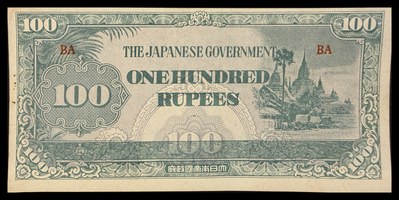
Shwedagon Pagoda in Yangon (Rangoon), Myanmar's most sacred Buddhist pagoda, believed to enshrine relics of four previous Buddhas including eight hairs of Gautama Buddha. The 99-meter gilded stupa dominates Yangon's skyline and has been the spiritual heart of Myanmar for over 2,600 years. This side bears the overprint 'THE JAPANESE GOVERNMENT / ONE HUNDRED RUPEES' with 'BA' block letters, indicating this is a World War II Japanese occupation currency note issued during the Burma Campaign (1942–1945). These overprinted notes were emergency currency used when Japanese forces occupied Burma.
History
This is a highly unusual composite or mismatched pair. The front appears to be a genuine modern Myanmar 50 kyat note from the Central Bank of Myanmar series (introduced 1994 after the military government's currency reforms). The back, however, shows a Japanese Government occupation note of 100 Rupees from World War II (1942–1945), used during Japan's occupation of Burma. These occupation rupees were issued by the Japanese military administration to replace British Indian rupees. The 'BA' block prefix indicates a specific print series. These are two entirely different notes from different eras—separated by approximately 50 years—and should not appear as front and back of the same note. This suggests either a scanning error, intentional composite for comparison, or a highly unusual numismatic anomaly. Genuine Japanese occupation rupees (catalog references typically in the P-14 to P-17 range for Burma) are collectible WWII-era notes, while modern Myanmar kyat notes are current legal tender.
Linked specimens (1)
Merge into another type
Repoints every linked specimen above to the chosen target type, fills any target nulls from this type, then deletes this type. This cannot be undone.