Type details
| Country | Nigeria |
| Currency | NGN |
| Denomination | 1 |
| Series | Second series |
| Series range | 1984–present |
| Issuer | Central Bank of Nigeria |
| Signatures | Governor: [illegible]; Chief of Banking Operations: [illegible] |
| Printer | Nigerian Security Printing and Minting Company |
| Front portrait | Young Nigerian person (representative portrait) |
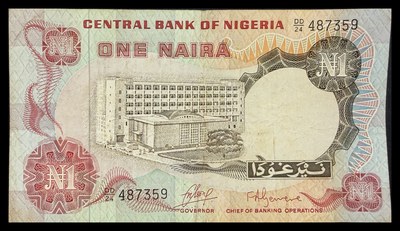
| Reverse subject | Central Bank of Nigeria headquarters building in Lagos |
| Themes | indigenous_culture,architecture |
| Watermark | Portrait of youth in clear field at left |
| Security features | thread,microprint,intaglio |
| Colour palette | #8b4513,#d2b48c,#a0522d |
| Material | paper |
| Dimensions (mm) | 151x78 |
| Language / script | Latin, Arabic |
| Languages | en,ha |
| Pick # | P-23 |
| Rarity | common |
| Legal status | withdrawn |
| Predecessor currency | Nigerian pound |
| Era | 1990_present |
| Default value (low) | 1.0 |
| Default value (high) | 3.0 |
| Value currency | USD |
Front
Representative portrait of a young Nigerian person with traditional facial marks (tribal scarification), symbolizing Nigeria's diverse ethnic heritage. The note features the denomination 'ONE NAIRA' prominently displayed, with the Nigerian coat of arms at lower center showing two horses supporting a black shield with a white wavy band (representing the Niger River), topped by an eagle. The design emphasizes national identity and cultural pride through indigenous representation.
Back
Central Bank of Nigeria headquarters building in Lagos, the modernist structure designed in the Brutalist architectural style and completed in the 1970s. The multi-story building, featuring characteristic horizontal lines of windows and concrete construction, served as the institution's main office during the period when Lagos was Nigeria's capital. Arabic script appears at center right, reflecting Nigeria's bilingual heritage (English and Hausa in Arabic script). The building represents the country's financial sovereignty and modern development.
History
This is part of Nigeria's second series of naira banknotes, introduced in 1984 following the first series issued in 1973 when Nigeria decimalized its currency (replacing the Nigerian pound with the naira at 2:1). The 1 naira note remained in circulation for decades as a workhorse denomination. The Central Bank of Nigeria was established in 1958, two years before independence, and moved to its Lagos headquarters shown on this note. The serial prefix 'DD/24' indicates a specific print run and series within the broader issue period. This design type with the youthful portrait and CBN building remained standard throughout the 1980s and 1990s until polymer notes were introduced for some denominations. The note is now withdrawn from active circulation but was demonetized only recently as Nigeria phases out lower-denomination notes due to inflation.
Linked specimens (1)
Merge into another type
Repoints every linked specimen above to the chosen target type, fills any target nulls from this type, then deletes this type. This cannot be undone.