Type details
| Country | North Korea |
| Currency | KPW |
| Denomination | 5000 |
| Issuer | Central Bank of the Democratic People's Republic of Korea |
| Issuer (native) | 조선민주주의인민공화국중앙은행 |
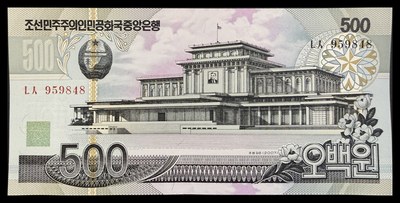
| Reverse subject | Kumsusan Palace of the Sun |
| Themes | architecture,commemorative |
| Security features | microprint,intaglio |
| Colour palette | #8b4513,#f5deb3,#d2691e |
| Material | paper |
| Dimensions (mm) | 157x67 |
| Language / script | Hangul (Korean script) |
| Languages | ko |
| Pick # | 46 |
| Rarity | scarce |
| Legal status | withdrawn |
| Era | 1990_present |
Front
Traditional Korean multi-tiered pavilion architecture, depicting what appears to be a historic temple or palace complex with characteristic curved rooflines and multiple levels. The architectural motif represents Korean cultural heritage and traditional building styles that symbolize national identity. The note features elaborate guilloche patterns and Korean-language inscriptions indicating the issuing authority.
Back
Kumsusan Palace of the Sun in Pyongyang, the mausoleum of Kim Il-sung and Kim Jong-il, formerly known as the Kumsusan Memorial Palace. This grand neoclassical building with its distinctive colonnaded facade serves as the resting place of North Korea's founding leader Kim Il-sung (d. 1994) and his son Kim Jong-il (d. 2011). The palace is one of the most significant political and ideological monuments in North Korea, representing the cult of personality surrounding the Kim dynasty. Magnolia blossoms appear at lower right, the national flower of North Korea.
History
This 5000 won note belongs to a series issued by the Central Bank of the Democratic People's Republic of Korea, likely from the 1990s or early 2000s era based on design characteristics and the inclusion of Kumsusan Palace. The note was part of North Korea's currency system before the 2009 revaluation (which caused significant economic disruption and was later partially reversed). The visible serial number 'LA 959848' suggests this is from a specific print run, though North Korean serial number systems are not publicly well-documented. The note has been withdrawn from circulation following currency reforms. The use of Kumsusan Palace on the reverse reflects the building's transformation into a mausoleum after Kim Il-sung's death in 1994, suggesting issue after that date. Without a visible printed year and given limited public documentation of North Korean currency series, precise dating requires caution.
Linked specimens (1)
Merge into another type
Repoints every linked specimen above to the chosen target type, fills any target nulls from this type, then deletes this type. This cannot be undone.