Type details
| Country | South Korea |
| Currency | KRW |
| Denomination | 10 won / 5 won |
| Issuer | Bank of Korea |
| Issuer (native) | 한국은행 |
| Security features | microprint,intaglio |
| Colour palette | #d4a5a5,#8b7355,#f5f5f5 |
| Material | paper |
| Language / script | Hangul (Korean alphabet) |
| Languages | ko |
| Legal status | demonetized |
Front
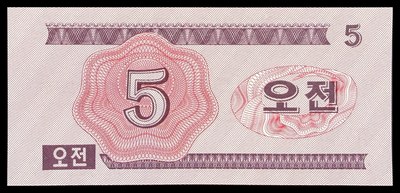
This appears to be a dual-denomination specimen or proof note displaying both 10 won (front) and 5 won (reverse) values. The front shows the numeral '10' in a guilloche rosette at center with Korean text '십원' (ten won) in a decorative box at right. The hangul character '십' appears in a box at lower left. The design features intricate line work and security patterns typical of mid-20th century Korean currency.
Back
The reverse displays the numeral '5' in a guilloche rosette at center with Korean text '오원' (five won) in a decorative box at right. The hangul character '오' appears in a box at lower left. The color scheme shifts to purple-red tones. This dual-denomination format suggests this is a specimen, proof, or sample note rather than a circulated banknote.
History
This note represents an unusual dual-denomination format showing both 10 won and 5 won values on opposite sides. Such pieces were typically produced as specimens, proofs, or printer's samples rather than for circulation. The Bank of Korea (한국은행) has issued won currency since 1950 following the establishment of the Republic of Korea. Small denomination notes like 5 and 10 won were common in the early decades but were eventually replaced by coins as inflation reduced their purchasing power. The simple geometric design with guilloche rosettes and minimal imagery is characteristic of early South Korean banknote design. Without visible signatures, dates, or serial numbers, and given the unusual dual-denomination format, this is most likely a specimen or sample piece. The exact series and issue date cannot be determined from the available evidence.
Linked specimens (1)
Merge into another type
Repoints every linked specimen above to the chosen target type, fills any target nulls from this type, then deletes this type. This cannot be undone.