Type details
| Country | Pakistan |
| Currency | PKR |
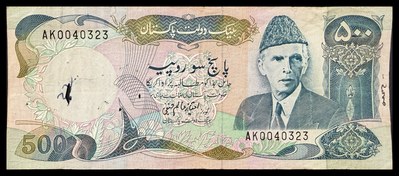
| Denomination | 10 Rupees (front) / 500 Rupees (back) |
| Issuer | State Bank of Pakistan |
| Issuer (native) | بینک دولت پاکستان |
| Front portrait | Muhammad Ali Jinnah |
| Reverse subject | Mohenjo-Daro |
| Themes | statesman,architecture |
| Colour palette | #8b7355,#d4c5a9,#2f4f4f |
| Material | paper |
| Language / script | Latin, Urdu (Nastaliq) |
| Languages | en,ur |
| Legal status | withdrawn |
Front
View of Mohenjo-daro archaeological site, one of the major settlements of the ancient Indus Valley Civilization (circa 2500–1900 BCE), located in Sindh province. The site features the Great Bath, residential structures, and the Stupa mound, representing Pakistan's ancient heritage. Mohenjo-daro is a UNESCO World Heritage Site and among the earliest major urban settlements in South Asia.
Back
Muhammad Ali Jinnah (1876–1948), founder of Pakistan and its first Governor-General, known as Quaid-e-Azam (Great Leader). He was a barrister, politician and statesman who led the All-India Muslim League and the Pakistan Movement, achieving the creation of Pakistan as an independent nation in 1947. Jinnah appears on virtually all Pakistani banknotes as the nation's founding father.
History
This appears to be a mismatched pair: the front shows a 10 Rupees note from the State Bank of Pakistan featuring Mohenjo-daro, while the back shows a 500 Rupees note featuring Muhammad Ali Jinnah with serial number AK0040323. The front is from an early series (likely 1970s-1980s based on design style and monochrome green-brown printing), while the back is from a later multicolored series (likely 1980s-1990s). Pakistani rupee notes from this era typically featured Jinnah on the obverse and various national landmarks, monuments, or economic scenes on the reverse. Without a matching pair, precise dating and Pick catalogue references cannot be reliably determined.
Linked specimens (1)
Merge into another type
Repoints every linked specimen above to the chosen target type, fills any target nulls from this type, then deletes this type. This cannot be undone.