Type details
| Country | Peru |
| Currency | PEN |
| Denomination | 100 Intis / 500 Intis |
| Series | Inti series |
| Series year | 1987 |
| Series range | 1985-1991 |
| Issue year | 1987 |
| Issuer | Banco Central de Reserva del Perú |
| Issuer (native) | BANCO CENTRAL DE RESERVA DEL PERÚ |
| Signatures | Presidente: [signature present]; Director: [signature present]; Gerente General: [signature present] |
| Reverse subject | José Gabriel Condorcanqui (Túpac Amaru II) |
| Themes | indigenous_culture,statesman,military |
| Watermark | Portrait of indigenous person in clear field at right |
| Security features | microprint,intaglio,latent_image |
| Colour palette | #d4a574,#8b4513,#f5deb3 |
| Material | paper |
| Language / script | Latin |
| Languages | es |
| Legal status | demonetized |
| Legal status date | 1991 |
| Predecessor currency | Sol |
| Successor currency | Nuevo Sol |
| Era | 1946_1989 |
Front
Industrial textile manufacturing scene showing a woman operating a mechanical loom with multiple spindles, representing Peru's textile industry and the country's heritage in textile production dating to pre-Columbian times. The imagery emphasizes the economic modernization efforts during the Inti currency period (1985-1991) while acknowledging Peru's long tradition of textile craftsmanship. Indigenous decorative motifs appear in the design including a ceremonial vessel and traditional geometric patterns.
Back
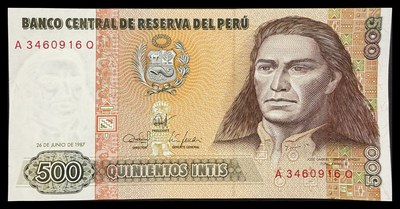
José Gabriel Condorcanqui, known as Túpac Amaru II (1738-1781), indigenous leader and cacique who led the largest Andean uprising against Spanish colonial rule in 1780-1781. As a direct descendant of the last Inca ruler, he organized a massive rebellion across the Peruvian highlands demanding the abolition of forced labor (mita), encomiendas, and colonial exploitation. He was captured and executed in Cusco in 1781, but became a powerful symbol of indigenous resistance and Peruvian national identity. The portrait shows him with long hair in traditional indigenous style, set against a background of Andean textile patterns. The printed date '26 DE JUNIO DE 1987' indicates this note was issued on June 26, 1987.
History
This note belongs to the Inti currency series issued by Peru from 1985 to 1991. The Inti replaced the Sol de Oro at a rate of 1,000 to 1 in February 1985 during President Alan García's first administration, as part of an attempt to control hyperinflation. However, the Inti itself suffered severe hyperinflation, with inflation exceeding 7,000% annually by 1990. The currency was replaced by the Nuevo Sol in 1991 at a rate of 1 million Intis to 1 Nuevo Sol. The note's imagery reflects the García government's nationalistic economic policies and emphasis on indigenous heritage. The front depicts industrial textile production while the back honors Túpac Amaru II, linking modern economic development to Peru's indigenous resistance history. The specific printed date of June 26, 1987 on this note places it during the period of economic crisis that would ultimately doom the Inti currency. The serial number format (A 3460916 Q) follows the standard prefix-number-suffix pattern used for Peruvian notes of this era.
Linked specimens (1)
Merge into another type
Repoints every linked specimen above to the chosen target type, fills any target nulls from this type, then deletes this type. This cannot be undone.