Type details
| Country | Bhutan |
| Currency | BTN |
| Denomination | 1 |
| Series | 2013 Series |
| Series year | 2013 |
| Series range | 2013–present |
| Issuer | Royal Monetary Authority of Bhutan |
| Issuer (native) | འབྲུག་རྒྱལ་རབས་པ |
| Signatures | Governor: signature present but name illegible from image |
| Reverse subject | Simtokha Dzong |
| Themes | architecture,religion |
| Security features | thread,microprint,intaglio |
| Colour palette | #c5c9e8,#d4a574,#4a5f8c |
| Material | paper |
| Dimensions (mm) | 138x65 |
| Language / script | Dzongkha (Tibetan script), English |
| Languages | dz,en |
| Pick # | P-27b |
| Rarity | common |
| Legal status | in_circulation |
| Predecessor currency | Indian Rupee |
| Era | 1990_present |
| Default value (low) | 1.0 |
| Default value (high) | 3.0 |
| Value currency | USD |
Front
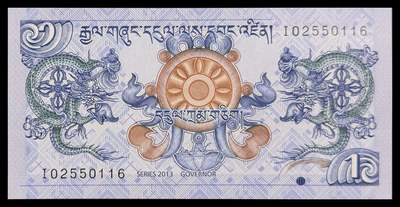
The Druk Khorlo, the Royal Emblem of Bhutan, occupies the center, featuring the dharma wheel (khorlo) flanked by two dragons (druk). The emblem represents the authority of the Buddhist religion and the Dragon King, symbolizing Bhutan's identity as 'Druk Yul' (Land of the Thunder Dragon). This sacred symbol combines the temporal and spiritual authority that has governed Bhutan since its unification in the 17th century. The note features ornate dragons in green and blue on either side and extensive geometric patterns across the surface.
Back
Simtokha Dzong (also Singtokha Dzong), Bhutan's first dzong fortress, built in 1629 by Zhabdrung Ngawang Namgyal who unified Bhutan. Located about 5 kilometers south of Thimphu, this fortress-monastery served as a strategic military installation and administrative center. The dzong exemplifies traditional Bhutanese architecture with its characteristic sloping walls, wooden details, and multi-tiered roofing. Now it houses the Institute for Language and Culture Studies and remains an important religious and cultural landmark in Bhutan.
History
This note belongs to the 2013 series of Bhutanese ngultrum, issued by the Royal Monetary Authority of Bhutan. The ngultrum has been pegged at parity with the Indian rupee since its introduction in 1974, though both currencies circulate in Bhutan. The 2013 series introduced updated security features while maintaining traditional Bhutanese iconography. The 1 ngultrum denomination is the lowest value note in active circulation and features prominent Buddhist and national symbols reflecting Bhutan's unique cultural identity.
Linked specimens (1)
Merge into another type
Repoints every linked specimen above to the chosen target type, fills any target nulls from this type, then deletes this type. This cannot be undone.