1 Peso Japanese Invasion Peso #421
Japanese Government (JIM) Issue
(1942–1945)
· M-8
· common
Type details
| Country | Philippines |
| Currency | Japanese Invasion Peso |
| Denomination | 1 Peso |
| Series | Japanese Government (JIM) Issue |
| Series range | 1942–1945 |
| Issuer | The Japanese Government |
| Issuer (native) | 大日本帝国政府 |
| Reverse subject | Government building (likely administrative center in Manila) |
| Themes | military,architecture |
| Colour palette | #d4c5a0,#4a4a4a,#8b7355 |
| Material | paper |
| Dimensions (mm) | 160x70 |
| Language / script | Latin, Japanese |
| Languages | en,ja |
| Pick # | M-8 |
| Rarity | common |
| Legal status | demonetized |
| Legal status date | 1945 |
| Predecessor currency | Philippine Commonwealth Peso |
| Successor currency | Philippine Victory Peso |
| Era | 1900_1945 |
Front
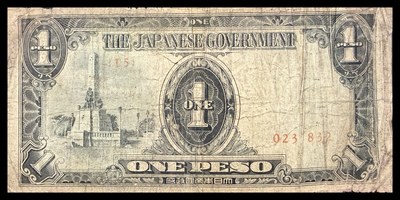
The front of this Japanese Invasion Money (JIM) 1 Peso note shows no portrait but features elaborate guilloche patterns and geometric security designs. The denomination '50' appears twice (erroneously, as this is actually the back of a 1 Peso note based on the reverse), with intricate lathe-work borders. This currency was issued during the Japanese occupation of the Philippines (1942–1945) and was printed in large quantities without precious metal backing, leading to hyperinflation by 1944.
Back
The reverse displays the text 'THE JAPANESE GOVERNMENT' across the top, with 'ONE PESO' at center and bottom. A government building, likely an administrative or legislative structure in Manila, appears at left. The serial number '023 83?' (partially visible) appears in red ink at right. Japanese characters '大日本帝国政府' appear at bottom. This occupation currency became worthless after liberation and is now a widely collected historical artifact of World War II in the Pacific.
History
Japanese Invasion Money (JIM) for the Philippines was issued from January 1942 following the Japanese occupation. The 1 Peso denomination was among the most common notes printed. These notes were declared legal tender by Japanese military authorities and circulated alongside (then replacing) Philippine Commonwealth currency. Production ramped up dramatically through 1944 as Japan printed vast quantities without backing, causing severe hyperinflation—by liberation in 1945 the currency was nearly worthless. After liberation, the Philippine government and US authorities declared JIM void and introduced Victory Series pesos. Today these notes are common in the collectors' market due to large surviving quantities. The note shows characteristics of the first and second JIM series issued 1942–1943, though without visible series markings or dates on the note itself, precise dating within the 1942–1945 window is difficult. No known public serial-year encoding has been documented for JIM issues.
Linked specimens (1)
Merge into another type
Repoints every linked specimen above to the chosen target type, fills any target nulls from this type, then deletes this type. This cannot be undone.