Type details
| Country | Romania |
| Currency | Leu |
| Denomination | 100 |
| Issuer | Banca Națională a Republicii Populare Române |
| Issuer (native) | BANCA NAȚIONALĂ A REPUBLICII POPULARE ROMÂNE |
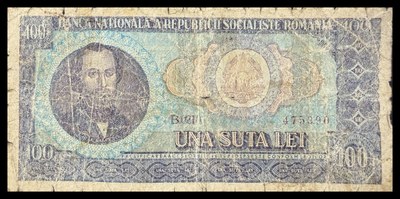
| Front portrait | Nicolae Bălcescu |
| Themes | statesman,commemorative |
| Security features | microprint,intaglio |
| Colour palette | #4a5f7a,#a8c5b5,#f5e6d3 |
| Material | paper |
| Language / script | Latin |
| Languages | pt,ro |
| Legal status | demonetized |
| Era | 1946_1989 |
Front
The Rossio Square (Praça de D. Pedro IV) in Lisbon, Portugal, depicted in early-to-mid 19th century style with crowded street scene showing civilians, carriages, and neoclassical architecture. The inscription 'O ROSSIO NOS PRINCIPIOS DO SECULO XIX' (The Rossio at the beginning of the 19th century) appears at bottom. This is a Portuguese 100 escudos note issued by Banco de Portugal, featuring historical scenes from Lisbon's urban life during the Romantic period.
Back
Nicolae Bălcescu (1819–1852), Romanian revolutionary, historian, and author; a central figure in the Wallachian Revolution of 1848 and advocate for national unity and peasant rights. The note displays his portrait at left with the Romanian coat of arms at center, issued during Romania's communist period when the issuer was styled 'Banca Națională a Republicii Populare Române' (National Bank of the People's Republic of Romania). Serial number B 2411 475391 visible. The denomination 'UNA SUTĂ LEI' (One Hundred Lei) is printed in Romanian.
History
This is a mismatched pair: the front shows a Portuguese 100 escudos note from Banco de Portugal featuring the Rossio Square in Lisbon in the early 19th century, while the back is from a Romanian 100 lei note issued by the Banca Națională a Republicii Populare Române featuring Nicolae Bălcescu. The Romanian note dates from the communist era (1947–1965 based on the issuer name 'Republicii Populare Române' which was used before the 1965 constitutional change to 'Republicii Socialiste România'). The Portuguese escudo series depicting historical Lisbon scenes was issued in various series during the mid-20th century. Without being able to match the designs properly or see both sides of the same note, precise catalogue attribution is impossible.
Linked specimens (1)
Merge into another type
Repoints every linked specimen above to the chosen target type, fills any target nulls from this type, then deletes this type. This cannot be undone.