Type details
| Country | Soviet Union |
| Currency | Soviet Ruble |
| Denomination | 10 |
| Series | Fourth Series |
| Series year | 1961 |
| Series range | 1961–1991 |
| Issue year | 1961 |
| Issuer | State Bank of the USSR |
| Issuer (native) | Государственного Банка СССР |
| Printer | Goznak |
| Front portrait | Vladimir Lenin |
| Reverse subject | Vladimir Lenin |
| Themes | statesman,communist |
| Watermark | Hammer and sickle with five-pointed star |
| Security features | microprint,intaglio,watermark |
| Colour palette | #c48b7f,#e8d4b0,#8b4513 |
| Material | paper |
| Dimensions (mm) | 157x67 |
| Language / script | Cyrillic |
| Languages | ru |
| Pick # | P-233 |
| Rarity | common |
| Legal status | demonetized |
| Legal status date | 1991 |
| Predecessor currency | Soviet Ruble (1947 series) |
| Successor currency | Russian Ruble |
| Era | 1946_1989 |
| Default value (low) | 2.0 |
| Default value (high) | 8.0 |
| Value currency | USD |
Front
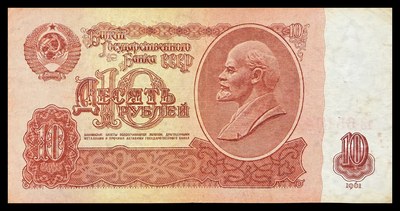
Vladimir Lenin (1870–1924), founder of the Soviet state and Bolshevik leader who led the October Revolution of 1917 and served as the first leader of Soviet Russia and the Soviet Union. Lenin's portrait appeared on Soviet banknotes from 1937 onwards and became the iconic symbol of Soviet currency. The front features the State Bank of the USSR emblem and multilingual denomination text in the languages of the Soviet republics.
Back
Vladimir Lenin in profile portrait at right, with the State Emblem of the Soviet Union (hammer and sickle surrounded by wheat stalks) at upper left. The text 'БИЛЕТЪ ГОСУДАРСТВЕННОГО БАНКА СССР' (Ticket of the State Bank of the USSR) and 'ДЕСЯТЬ РУБЛЕЙ' (Ten Rubles) is prominently displayed. The design represents the standardized Soviet currency aesthetic of the 1961 monetary reform.
History
This note belongs to the Fourth Series of Soviet currency, introduced during Khrushchev's monetary reform of January 1, 1961, which redenominated the ruble at a 10:1 ratio to combat inflation and simplify accounting. The 1961 series remained in circulation until the dissolution of the USSR in 1991, making it the longest-running Soviet banknote series. Designed with enhanced security features and standardized sizing, this series reflected the relative economic stability of the Brezhnev era. The multilingual text reflects the multinational character of the USSR, including Russian and translations in languages of constituent republics. The date '1961' is printed on the note. These notes were demonetized following the collapse of the Soviet Union and replaced by Russian Federation currency in 1992–1993.
Linked specimens (1)
Merge into another type
Repoints every linked specimen above to the chosen target type, fills any target nulls from this type, then deletes this type. This cannot be undone.