5 Soviet Ruble #454
Fourth series Soviet ruble
(1961–1991)
· issued 1961
· 224
· common
Type details
| Country | Soviet Union |
| Currency | Soviet Ruble |
| Denomination | 5 |
| Series | Fourth series Soviet ruble |
| Series year | 1961 |
| Series range | 1961–1991 |
| Issue year | 1961 |
| Issuer | State Bank of the USSR |
| Issuer (native) | ГОСУДАРСТВЕННЫЙ КАЗНАЧЕЙСКИЙ БИЛЕТ СССР |
| Printer | Goznak |
| Reverse subject | Spasskaya Tower of the Moscow Kremlin |
| Themes | architecture,statesman |
| Watermark | Stars pattern in clear field |
| Security features | intaglio,microprint |
| Colour palette | #e6d5b8,#c19a6b,#8b7355 |
| Material | paper |
| Dimensions (mm) | 114x59 |
| Language / script | Cyrillic, Latin, Georgian, Armenian |
| Languages | ru,uk,be,uz,kk,az,ka,hy,tk,ky,tg,lt,lv,et |
| Pick # | 224 |
| Rarity | common |
| Legal status | demonetized |
| Legal status date | 1991 |
| Predecessor currency | Soviet Ruble (Third series, 1947) |
| Successor currency | Russian Ruble |
| Era | 1946_1989 |
| Default value (low) | 2.0 |
| Default value (high) | 8.0 |
| Value currency | USD |
Front
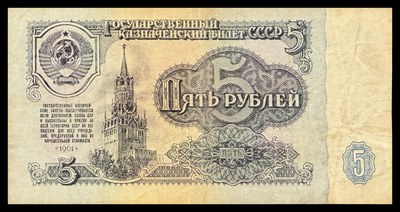
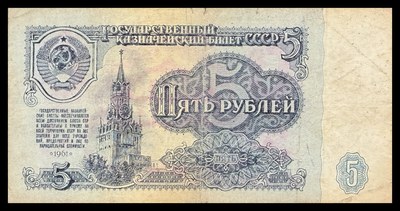
State Treasury Note of the USSR (Государственный казначейский билет СССР), 5 rubles denomination. The note features multilingual inscriptions stating 'ПЯТЬ РУБЛЕЙ' (Five Rubles) in Russian and the value repeated in the languages of all 15 Soviet republics (including Georgian, Armenian, Azerbaijani, Kazakh, Uzbek, and others). The front includes ornate guilloche patterns forming rosettes and decorative frames typical of Soviet banknote design, with the text 'Подделка государственных казначейских билетов преследуется по закону' (Counterfeiting of state treasury notes is prosecuted by law) at bottom. This design represented the unified monetary system of all Soviet Socialist Republics from 1961 until the dissolution of the USSR.
Back
Spasskaya Tower of the Moscow Kremlin, the iconic clock tower facing Red Square. Built in 1491 by Italian architect Pietro Antonio Solari and topped with its distinctive star in the Soviet era, the Spasskaya Tower is the most recognizable of the Kremlin's towers and serves as the main entrance to the Kremlin. The clock, installed in the 16th century and modified multiple times, is a symbol of Russian timekeeping and state authority. The note displays 'ГОСУДАРСТВЕННЫЙ КАЗНАЧЕЙСКИЙ БИЛЕТ СССР' (State Treasury Note of the USSR) at top, with the Soviet coat of arms featuring hammer and sickle at upper left, and the date '1961' at lower left indicating the year of the 1961 monetary reform.
History
This is the 5-ruble State Treasury Note from the Fourth series of Soviet rubles, issued following the January 1961 monetary reform (денежная реформа 1961 года) that redenominated the currency at a ratio of 10:1. The reform replaced the Third series (1947) notes with new lower-denomination currency, with this 5-ruble note being one of the smallest denominations issued. The 1961 series remained in circulation throughout the remainder of Soviet history until the USSR's dissolution in 1991, when these notes were demonetized and replaced by the currencies of the newly independent republics, primarily the Russian ruble. The design emphasized Soviet multinational unity by displaying the denomination in all 15 republican languages. The dated '1961' printed on the note directly indicates the year of this monetary reform. The Spasskaya Tower reverse motif reinforced Moscow and the Kremlin as the center of Soviet power. These notes were printed by Goznak (Гознак), the Soviet state security printing works. The serial number format 'ЮЭ 3071047' is typical for this series, with Cyrillic prefix letters used for different print runs.
Linked specimens (2)
Merge into another type
Repoints every linked specimen above to the chosen target type, fills any target nulls from this type, then deletes this type. This cannot be undone.