Type details
| Country | Slovenia |
| Currency | SIT |
| Denomination | 20 |
| Series | Tolar series |
| Series year | 1992 |
| Series range | 1992-2007 |
| Issue year | 1992 |
| Issuer | Bank of Slovenia |
| Issuer (native) | Banka Slovenije |
| Themes | mythology,architecture |
| Security features | microprint,intaglio,see_through_register |
| Colour palette | #f5deb3,#d2b48c,#8b4513 |
| Material | paper |
| Dimensions (mm) | 136x68 |
| Language / script | Latin |
| Languages | sl |
| Pick # | 12a |
| Rarity | common |
| Legal status | demonetized |
| Legal status date | 2007-01-01 |
| Predecessor currency | Yugoslav dinar |
| Successor currency | Euro |
| Era | 1990_present |
| Default value (low) | 1.0 |
| Default value (high) | 3.0 |
| Value currency | USD |
Front
Decorative design featuring a mythological motif with putti (cherubs) and the Latin motto "Dulcis ex labore fructus" (Sweet is the fruit of labor). The note displays complex guilloché patterns in yellow, orange and brown tones. The date "LJUBLJANA 15.JANUAR 1992" marks Slovenia's formal recognition as an independent state. The design represents Slovenia's newly established currency following independence from Yugoslavia in 1991.
Back
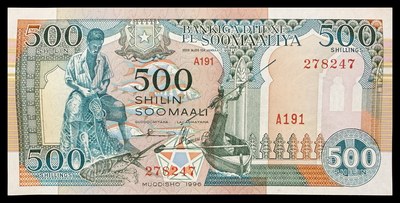
This is a mismatched pair showing a Somali 500 Shillings note (Pick 36c, dated 1996) from the Central Bank of Somalia (Bankiga Dhexe Ee Soomaaliya). The back depicts a traditional Somali sailing vessel (dhow) and a woman in traditional dress with a basket. Serial number A191 278247 is visible. The note features the Somali coat of arms with two leopards supporting a shield with a white star.
History
The Slovenian tolar (SIT) was introduced on 8 October 1991 following Slovenia's declaration of independence from Yugoslavia in June 1991. The 20 tolar note was part of the first series issued on 15 January 1992, as indicated by the printed date. This series featured decorative motifs rather than portraits, reflecting Slovenia's new national identity. The tolar served as Slovenia's currency until 1 January 2007, when Slovenia became the first of the 2004 EU accession countries to adopt the euro. The note shown here is from the initial 1992 issue.
Linked specimens (1)
Merge into another type
Repoints every linked specimen above to the chosen target type, fills any target nulls from this type, then deletes this type. This cannot be undone.