Type details
| Country | North Korea |
| Currency | KPW |
| Denomination | 50 |
| Series range | 1959–1962 |
| Issuer | Central Bank of the Democratic People's Republic of Korea |
| Issuer (native) | 조선민주주의인민공화국중앙은행 |
| Reverse subject | Industrial complex with refinery towers and equipment |
| Themes | industry,architecture |
| Security features | microprint,intaglio |
| Colour palette | #d4b896,#8ab4d4,#2e2e2e |
| Material | paper |
| Language / script | Hangul (Korean) |
| Languages | ko |
| Pick # | 14 |
| Rarity | scarce |
| Legal status | demonetized |
| Legal status date | 1962 |
| Predecessor currency | North Korean won (1947) |
| Successor currency | North Korean won (1962 reform) |
| Era | 1946_1989 |
| Default value (low) | 15.0 |
| Default value (high) | 40.0 |
| Value currency | USD |
Front
Industrial refinery complex with multiple distillation towers, pressure vessels, and processing equipment. This represents North Korea's post-Korean War emphasis on heavy industry and petroleum refining as part of the DPRK's socialist industrialization program initiated in the late 1950s. A map of the Korean peninsula appears on the right side, symbolizing national unity claims.
Back
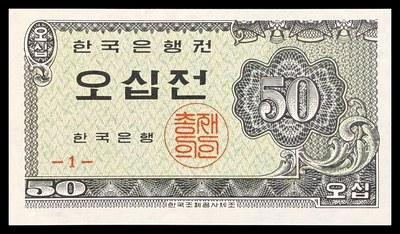
Denomination '50' (오십전, fifty jeon) prominently displayed in Korean script with ornate guilloche patterns and intricate border designs. The text '한국은행권' (Bank of Korea Note) appears at top, with '한국은행' (Bank of Korea) repeated below. A red circular seal/stamp marked '-1-' appears at center left.
History
This note belongs to the first series of the second North Korean won, issued 1959–1962 by the Central Bank of the DPRK (established 1946). The denomination is 50 jeon (전), a subunit equal to 1/100 won. This series replaced the 1947 won at par and emphasized industrial imagery reflecting Kim Il-sung's Chollima Movement (1956–1961) for rapid socialist reconstruction after the Korean War. The series was demonetized in 1962 during a currency reform that introduced new won notes. The '-1-' marking on the back is a control number or block indicator. The bilingual 'Bank of Korea' inscription (한국은행) reflects the DPRK's claim to represent all of Korea. These notes circulated briefly during a period of post-war economic recovery and are now scarce due to the short circulation period and subsequent withdrawal.
Linked specimens (1)
Merge into another type
Repoints every linked specimen above to the chosen target type, fills any target nulls from this type, then deletes this type. This cannot be undone.