Type details
| Country | Sri Lanka |
| Currency | LKR |
| Denomination | 20 |
| Series | 2010 series |
| Series year | 2010 |
| Series range | 2010–present |
| Issue year | 2010 |
| Issuer | Central Bank of Sri Lanka |
| Issuer (native) | ශ්රී ලංකා මහ බැංකුව |
| Signatures | Governor: Ajith Nivard Cabraal |
| Front portrait | Traditional Kandyan dancer |
| Reverse subject | Colombo Port |
| Themes | indigenous_culture,transport,industry,wildlife |
| Watermark | Chinthe (mythical lion) in clear field at right |
| Security features | thread, microprint, intaglio, see_through_register, latent_image, uv |
| Colour palette | #c85a5a,#f5deb3,#8b4513 |
| Material | paper |
| Dimensions (mm) | 137x65 |
| Language / script | Sinhala, Tamil, Latin |
| Languages | si,ta,en |
| Pick # | P-123 |
| Rarity | common |
| Legal status | in_circulation |
| Legal status date | 2010-01-01 |
| Era | 1990_present |
| Default value (low) | 2.0 |
| Default value (high) | 5.0 |
| Value currency | USD |
Front
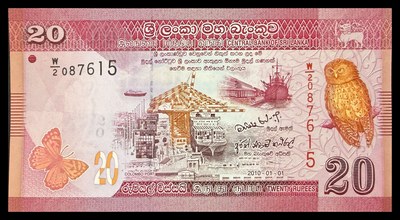
Traditional Kandyan dancer in ceremonial costume. Kandyan dance is one of Sri Lanka's most iconic cultural traditions, originating in the hill country Kingdom of Kandy during the 15th–19th centuries. The elaborate costume includes the distinctive ves costume with silver ornaments, headdress (ves thattuva), chest ornament, bangles, ankle bells, and ritual objects. This classical dance form was traditionally performed at temple ceremonies and royal courts, and remains a central element of Sri Lankan cultural identity. The dancer is shown mid-performance with ritual drums (geta bera) visible in the composition.
Back
Colombo Port, Sri Lanka's principal maritime gateway and one of South Asia's busiest container terminals. The port, located in the capital Colombo on the west coast, has been a major trading hub since ancient times and underwent significant modernization in the 20th and 21st centuries. The design shows modern port infrastructure including container cranes, cargo ships, and port facilities, representing Sri Lanka's role in international trade and its strategic position on Indian Ocean shipping routes. The scene includes the Ceylon Petroleum Corporation terminal and modern container handling equipment. Wildlife elements include a jungle owlet (Glaucidium radiatum), a small owl species native to Sri Lanka and southern India, and a butterfly (likely the Common Redbreast or Ceylon Tree Nymph), representing the island's rich biodiversity.
History
This note belongs to the 2010 series issued by the Central Bank of Sri Lanka, which introduced updated security features and designs while maintaining traditional Sri Lankan cultural and economic themes. The date 2010-01-01 is clearly printed on the reverse. The series was issued during the governorship of Ajith Nivard Cabraal (2006–2015). The 20 rupee denomination features Kandyan cultural heritage on the obverse and modern economic infrastructure on the reverse, reflecting Sri Lanka's balance between cultural preservation and economic development. The note incorporates trilingual text in Sinhala, Tamil, and English, reflecting Sri Lanka's multilingual society. Serial number W/2 2087615 indicates prefix W/2.