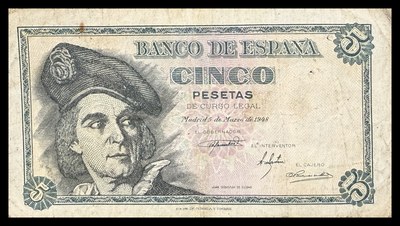
Type details
| Country | Spain |
| Currency | ESP |
| Denomination | 100 Pesetas |
| Series | Issue of 1948 |
| Series range | 1948–1953 |
| Issue year | 1948 |
| Issuer | Banco de España |
| Signatures | El Gobernador: illegible; El Interventor: illegible; El Cajero: illegible |
| Printer | Fábrica Nacional de Moneda y Timbre |
| Front portrait | Juan Sebastián Elcano |
| Reverse subject | Generalife gardens at the Alhambra |
| Themes | statesman,military,architecture |
| Security features | intaglio |
| Colour palette | #8b4513,#d2b48c,#2f4f4f |
| Material | paper |
| Dimensions (mm) | 154x103 |
| Language / script | Latin |
| Languages | es |
| Pick # | 137 |
| Rarity | common |
| Legal status | demonetized |
| Legal status date | 2002 |
| Successor currency | Euro |
| Era | 1946_1989 |
| Default value (low) | 5.0 |
| Default value (high) | 15.0 |
| Value currency | USD |
Front
The Generalife gardens and palace at the Alhambra complex in Granada, Spain. Built in the 13th–14th centuries as the summer palace and country estate of the Nasrid emirs of Granada, the Generalife is renowned for its terraced gardens, fountains, and courtyards; it is among the finest examples of Moorish garden architecture and a UNESCO World Heritage Site component of the Alhambra ensemble.
Back
Juan Sebastián Elcano (1476–1526), Spanish Basque navigator and explorer who completed the first circumnavigation of the Earth after Ferdinand Magellan's death in 1521. Elcano commanded the Victoria back to Spain in 1522, becoming the first person to successfully circle the globe; he is one of the most celebrated figures in Spanish maritime history and his feat established Spain as a global naval power.
History
This note belongs to the post-Civil War banknote series issued by Banco de España dated 5 March 1948 ("Madrid 5 de Marzo de 1948" printed on the back). The series was issued during Franco's dictatorship and circulated during Spain's economic reconstruction period. The 100 pesetas denomination was printed by the Fábrica Nacional de Moneda y Timbre (the Spanish national mint and printing works) as indicated by the printer's mark at the bottom of the back. This design pairing Elcano with the Generalife was part of Spain's nationalist cultural programme under Franco, emphasising Spanish imperial and cultural heritage. The peseta remained Spain's currency until the euro adoption in 2002. Pick catalogue reference P-137 with multiple signature varieties documented for this series.