Type details
| Country | Thailand |
| Currency | THB |
| Denomination | 20 |
| Series | 9th series |
| Series range | 1971-1988 |
| Issuer | Bank of Thailand |
| Issuer (native) | ธนาคารแห่งประเทศไทย |
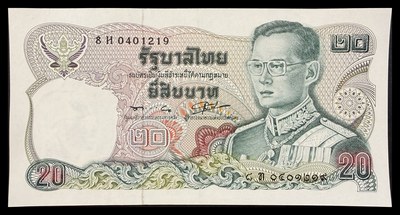
| Front portrait | King Bhumibol Adulyadej (Rama IX) |
| Reverse subject | Equestrian statue of King Chulalongkorn (Rama V) |
| Themes | monarch,statesman,military |
| Security features | microprint,intaglio |
| Colour palette | #8b6f47,#2f4f4f,#d4a574 |
| Material | paper |
| Dimensions (mm) | 156x72 |
| Language / script | Thai script with Arabic numerals |
| Languages | th |
| Pick # | 88 |
| Rarity | common |
| Legal status | demonetized |
| Era | 1946_1989 |
| Default value (low) | 2.0 |
| Default value (high) | 8.0 |
| Value currency | USD |
Front
Equestrian statue of King Chulalongkorn (Rama V, reigned 1868-1910), the fifth monarch of Siam under the Chakri dynasty and one of Thailand's most revered kings. King Chulalongkorn modernized Siam, abolished slavery, reformed the government and military, and preserved Thai independence during the colonial era. The statue depicted is the Royal Plaza Monument in Bangkok, erected in 1908.
Back
King Bhumibol Adulyadej (Rama IX, 1927-2016), the ninth monarch of Thailand's Chakri dynasty who reigned from 1946 to 2016, making him the world's longest-reigning monarch at the time of his death. He is shown wearing military uniform with decorations and glasses. Bhumibol was deeply revered in Thailand for his development projects, moral authority, and dedication to his people throughout seven decades of rule.
History
This note belongs to the 9th series of Thai banknotes issued by the Bank of Thailand during the reign of King Rama IX. The series was introduced in 1971 and circulated through 1988, featuring portraits of King Bhumibol Adulyadej on the back and various historical and cultural subjects on the front. The 20 baht denomination features the equestrian statue of King Chulalongkorn, honoring the modernizing monarch who preserved Thai sovereignty. Serial number 8H0401219 visible on back; Thai numerals also used. This series represents the transition period in Thai currency design before polymer notes. The Garuda emblem (mythical bird of Hindu-Buddhist tradition and symbol of royal authority) appears prominently on both sides.
Linked specimens (1)
Merge into another type
Repoints every linked specimen above to the chosen target type, fills any target nulls from this type, then deletes this type. This cannot be undone.