5000 Karbovanets #547
Karbovanets series
(1992–1996)
· issued 1995
· P-93
· common
Type details
| Country | Ukraine |
| Currency | Karbovanets |
| Denomination | 5000 |
| Series | Karbovanets series |
| Series year | 1995 |
| Series range | 1992–1996 |
| Issue year | 1995 |
| Issuer | National Bank of Ukraine |
| Issuer (native) | Національний банк України |
| Reverse subject | Berestechko Monument |
| Themes | statesman,military,indigenous_culture,commemorative |
| Security features | microprint,guilloche |
| Colour palette | #8b4513,#87ceeb,#d2691e |
| Material | paper |
| Language / script | Cyrillic |
| Languages | uk |
| Pick # | P-93 |
| Rarity | common |
| Legal status | demonetized |
| Legal status date | 1996-09-16 |
| Predecessor currency | Soviet ruble |
| Successor currency | Ukrainian hryvnia |
| Era | 1990_present |
| Default value (low) | 1.0 |
| Default value (high) | 5.0 |
| Value currency | USD |
Front
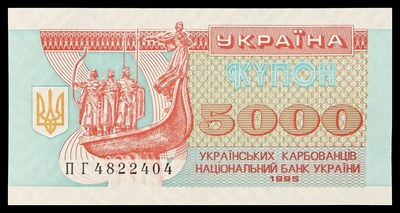
The Berestechko Monument depicting three Ukrainian Cossack figures standing together holding a flag on an ornate boat-like vessel. This monument commemorates the Battle of Berestechko (1651), one of the largest land battles of the 17th century fought between the Cossack Hetmanate and the Polish-Lithuanian Commonwealth. The front features elaborate baroque-style ornamental borders with medallions showing St. George slaying the dragon, a traditional symbol associated with both Kyivan Rus and Cossack imagery.
Back
The Verkhovna Rada building (Supreme Council of Ukraine) in Kyiv, the seat of the Ukrainian parliament. Originally constructed as the Communist Party headquarters during the Soviet era, the building became the home of Ukraine's independent parliament after 1991. The neoclassical structure with its colonnade is depicted across the top of the note in brown ink, framed by decorative borders. The back also shows the tryzub (trident) coat of arms of Ukraine and the denomination of 5000 karbovantsiv.
History
This 5000 karbovanets note was issued by the National Bank of Ukraine in 1995 during the hyperinflationary period following Ukrainian independence in 1991. The karbovanets (also called kupon or coupon) was introduced in 1992 as a transitional currency to replace the Soviet ruble, but suffered severe devaluation through the mid-1990s. The series 1992–1996 saw denominations rise from 1 to 1,000,000 karbovantsiv as hyperinflation peaked. This note was demonetized on September 16, 1996 when Ukraine introduced the hryvnia at a conversion rate of 100,000 karbovantsiv = 1 hryvnia. The imagery reflects newly independent Ukraine's emphasis on Cossack heritage and national symbols. The date 1995 is clearly printed at the bottom of the reverse.
Linked specimens (1)
Merge into another type
Repoints every linked specimen above to the chosen target type, fills any target nulls from this type, then deletes this type. This cannot be undone.